 BETA
Person
Charles V
1500–1558 · Holy Roman Emperor · Holy Roman Empire
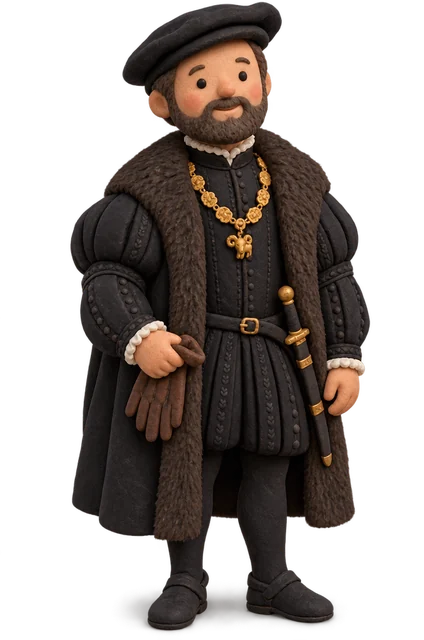
An emperor who ruled Spain, the Netherlands and even Austria; he tried to stop the Reformation but could not.
Charles V was an emperor who ruled Spain, Germany and the Netherlands. He tried to stop the Reformation but could not. Worn out, he stepped down as emperor of his own will.
More detail
Two sources checked
Charles V was born in 1500 in Ghent, in present-day Belgium. From his grandfathers and grandmothers he inherited an enormous amount of land, including the Netherlands, Spain with its American colonies, and Austria. In 1516 he became King of Spain (Carlos I), and in 1519 he was elected Holy Roman Emperor.
He dreamed of a Christian world united under the Catholic Church. At the Diet of Worms in 1521 he declared Luther an outlaw, but pressed by wars with France and the Ottoman Empire, he found it hard to concentrate his strength on Germany’s religious problem. In 1530 he received the imperial crown from the Pope at Bologna, and he was the last emperor to receive the crown from a pope.
In 1547 at Mühlberg he defeated the Lutheran princes but could not eradicate Protestantism, and finally in 1555 the Peace of Augsburg recognized both faiths together.
Worn out, in 1556 he stepped down of his own accord, handing the Spanish lands to his son Philip II and the imperial title to his brother Ferdinand. He died in 1558 at the monastery of Yuste in Spain.
Life timeline
- 1516Became King of Spain
- 1530Received the imperial crown at Bologna
- 1556Stepped down from the imperial throne of his own accord
Related events
- 1516Charles I Becomes King of Spain
- 1519Election of Charles V as Emperor
- 1521Diet of Worms
- 1546Schmalkaldic War