 BETA
Person
Martin Luther
1483–1546 · Reformer · Holy Roman Empire
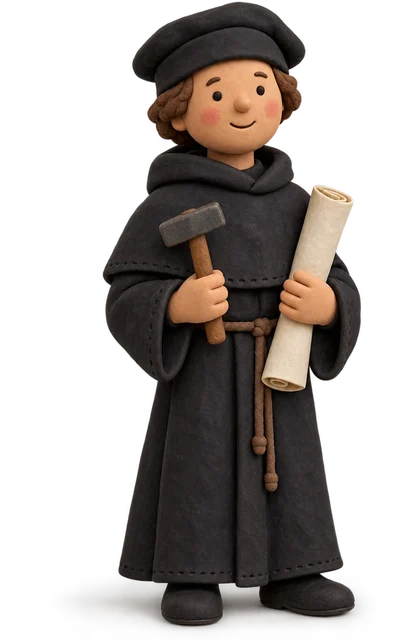
Born in Saxony in 1483, this monk and university professor began the Reformation in 1517 with his 95 Theses criticizing the sale of indulgences, and translated the Bible into German at Wartburg Castle. He is criticized for his writings on the Peasants' War and on Jews, alongside his great achievements.
How did a man who became a monk after lightning struck near him change history? Luther was a German monk and university professor. He began the Reformation, calling for the church's wrongs to be fixed, and translated the Bible into German so anyone could read it. But his writings on the Peasants' War and on Jews are criticized today.
More detail
Two sources checked
Could lightning striking right beside you change your life? Martin Luther was born in 1483 in Eisleben, Saxony, into a family that worked in mining. His father wanted him to become a lawyer, but in 1505, after nearly being struck by a great bolt of lightning, he entered the Augustinian monastery in Erfurt.
Becoming a professor of the Bible at the University of Wittenberg, Luther came to the belief that "people are saved not by good deeds or money, but by faith alone." In 1517 he put forward his 95 Theses criticizing the sale of indulgences, and when they were printed they spread across all of Germany.
In 1521 he was excommunicated by the pope, and at the Diet of Worms he refused to take back his claims and became an outlaw. Perhaps he saw it as something he could not give way on. Protected by the Elector of Saxony, he hid in Wartburg Castle and translated the New Testament into German.
In 1525 he married Katharina von Bora, a former nun, setting an example that pastors could have families too. He wrote hymns and catechisms and shaped the new church. On the other hand, his urging the princes to crush the uprising during the Peasants' War, and his harsh writings against Jews in his later years, are criticized today. He died in 1546 in his hometown of Eisleben.
It was a life that left both light and shadow. From him we can learn to look at great achievements and mistakes together.
Life timeline
- 1505Entered the monastery
He entered the Augustinian monastery in Erfurt. - 1512Became a doctor of theology and professor at the University of Wittenberg
- 1521Excommunicated by the Pope
- 1525Married Katharina von Bora
Related events
- 1517Start of the Reformation (Luther's 95 Theses)
- 1519Leipzig Disputation
- 1521Diet of Worms
- 1521Luther's Translation of the Bible into German
- 1522The Luther Bible and the German Language: A Single Written Language Grows
- 1522Luther's New Testament, the "September Testament," Appears
- 1524German Peasants' War
- 1530Luther's "Open Letter on Translating": What Is Translation?
- 1531The Wittenberg Translation Circle: A Bible Translated and Corrected Together