 BETA
Person
Otto von Bismarck
1815–1898 · Chancellor of the German Empire · German Empire
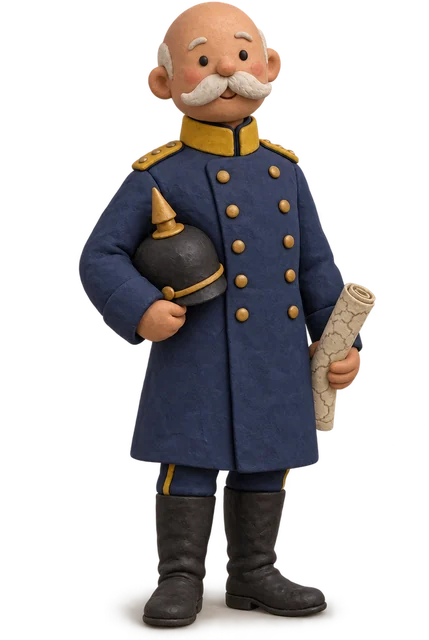
The "Iron Chancellor" Bismarck became Prussia's prime minister in 1862, founded the German Empire in 1871 through wars with Denmark, Austria and France and through diplomacy, and became its first chancellor. He is judged both for creating social insurance and for his limited respect for parliament.
How did Bismarck make a scattered Germany into one? As prime minister of Prussia, he founded the German Empire in 1871 through war and diplomacy and became its first chancellor. After unification he tried to keep the peace through alliances, and he also created the world's first health, accident and pension insurance. But he is criticized for treating parliament and democracy lightly, so we should also look back at how his great deeds were achieved.
More detail
Two sources checked
Is it possible to make one country out of land split into many states? It is like tying several classes that all do their own thing into one team, and the person who pulled it off was Bismarck. He was born in 1815 into a Junker (Prussian landowning noble) family in Schönhausen, Prussia. He studied law, became a legislator in 1847, and served as envoy to the German Confederation and as ambassador to Russia and France.
When he became prime minister of Prussia in 1862, Bismarck stood against parliament with his "iron and blood" speech and built up the army. Standing against parliament must have been a tense tug-of-war. Perhaps he believed that unification could not be achieved with words alone.
Things then moved fast. He won wars against Denmark in 1864, Austria in 1866 and France in 1870 one after another, and in 1871 the German Empire was founded at Versailles. Bismarck became the first chancellor of that empire.
After unification he changed his face from the sword to diplomacy. He tried to keep the peace in Europe with alliances that isolated France, and he led the Berlin Conference in 1884. At home he suppressed the Catholic Church and the socialists, but he created the world's first health, accident and pension insurance. He held people down on one side and looked after their living on the other, so judgments of him cannot be summed up in a word.
In 1890 he clashed with the young Emperor Wilhelm II and stepped down, and in 1898 he died at Friedrichsruh, near Hamburg. He is highly regarded as the statesman who achieved unification, but he is criticized for treating parliament and democracy lightly. Bismarck teaches us that how a great deed is done matters as much as the deed itself.
Life timeline
- 1862Became Prussian prime minister
- 1871Became first chancellor of the German Empire
Related events
- 1862Bismarck's Blood and Iron Policy
- 1864Danish War (Second Schleswig War)
- 1866Austro-Prussian War and the North German Confederation
- 1870Franco-Prussian War and the Battle of Sedan
- 1871Proclamation of the German Empire (German Unification)
- 1882Triple Alliance Signed
- 1883Bismarck's Social Insurance System
- 1884Berlin Conference (Partition of Africa)
- 1890Bismarck's Dismissal and Wilhelm II's World Policy