 BETA
Person
Wilhelm Conrad Röntgen
1845–1923 · Physicist · German Empire
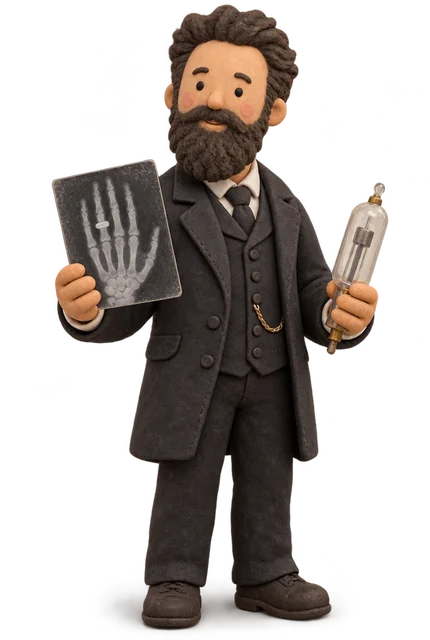
A physicist who discovered X-rays and won the first Nobel Prize in Physics.
Röntgen was a scientist who discovered X-rays, which can take pictures of the bones inside the body. In 1901, he received the first Nobel Prize in Physics. He did not make money from this discovery and let everyone use it.
More detail
Two sources checked
Röntgen was born in 1845 in Lennep in the Rhineland, the only son of a cloth merchant. He spent his childhood in the Netherlands and studied mechanical engineering and physics at the Polytechnic in Zurich, Switzerland.
After Strasbourg and Giessen, in 1888 he became professor of physics at the University of Würzburg. On 8 November 1895, while doing a cathode ray experiment, he discovered an unknown light that passed through black paper and named it “X-rays.”
He did not tie up his discovery with a patent, so that anyone could use it. In 1901 he received the first Nobel Prize in Physics and gave the prize money to the university.
From 1900 he worked as a professor at the University of Munich, and he died in Munich in 1923. Even now X-ray pictures are called “Röntgen pictures.”
Life timeline
- 1888Became professor at the University of Würzburg
- 1901Received the first Nobel Prize in Physics