 BETA
Person
Charles I
1500–1558 · King of Spain · Kingdom of Spain (Habsburg Dynasty)
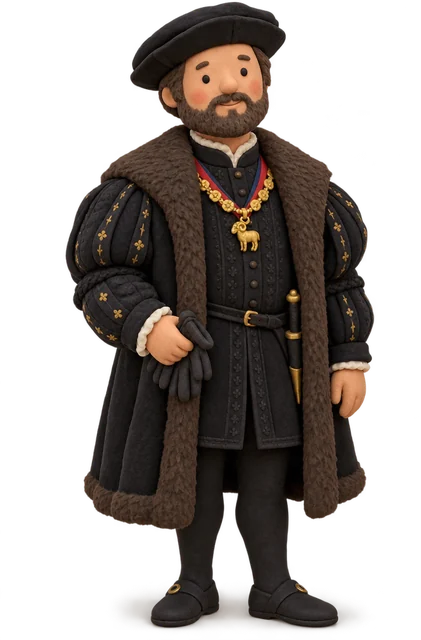
Born in Ghent in 1500, he became King of Spain and, as Charles V, Holy Roman Emperor. He ruled a huge empire spread across Europe and the Americas, stepped down of his own will in 1556, and died in 1558.
Could one person really inherit so many countries? Charles I was King of Spain and Holy Roman Emperor, and he ruled wide lands across Europe and the Americas. He spent his days busy fighting France and the Ottoman Empire, grew tired, and stepped down of his own will in 1556. His life shows that letting go at the right time matters too.
More detail
Two sources checked
Could one person really inherit so many countries? Charles I was born in Ghent, in Flanders, in 1500, the son of Philip I of the House of Habsburg and Joanna of Castile. From his grandfathers he inherited, one after another, the Netherlands (1506), Spain with southern Italy and the Americas (1516), and Austria (1519). In 1519 he was elected Holy Roman Emperor as Charles V. Today it would be like being made class president of several groups all at once.
The job was not easy. After putting down the Comuneros revolt, he made Spain the center of his empire. In his time Cortes and Pizarro brought down the Aztecs and the Incas, and Magellan and Elcano sailed around the world. Meanwhile he fought France many times (the Battle of Pavia in 1525) and had to face the Ottoman Empire and the Protestant princes. From where he sat, every side probably looked like a problem to be solved.
Then, worn out, he made a great decision. In 1556 he stepped down of his own will, giving Spain to his son Philip II and the imperial throne to his brother Ferdinand. He lived next to the Yuste monastery and died there in 1558. In Germany he is known as Charles V.
What is more amazing than owning so much land may be that he knew how to let go of it. His life shows that handing a job over at the right time matters as much as taking it on.
Life timeline
- 1516Becomes King of Spain
- 1519Elected Holy Roman Emperor
- 1556Abdicates the throne