 BETA
Person
Philip II
1527–1598 · King of Spain · Kingdom of Spain (Habsburg Dynasty)
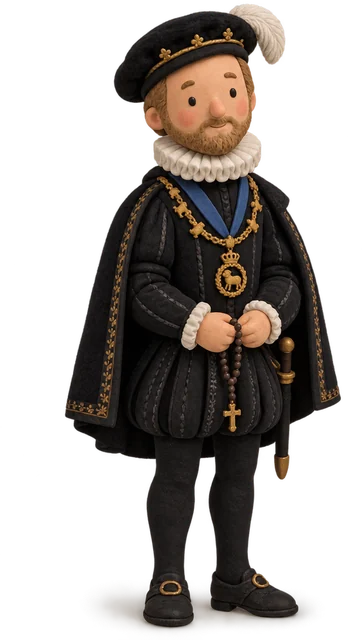
Born in Valladolid in 1527, he became King of Spain in 1556, set his court in Madrid, and from El Escorial ruled the "empire on which the sun never sets," spanning the Americas and Asia. He died in 1598.
How do you rule an empire on which the sun never sets? Philip II was the Spanish king who ruled lands from the Americas to the Philippines. He made Madrid his capital and read papers himself, so he was called the "Paper King." The Philippines even got its name from him, but he also faced failed wars and the state going bankrupt. The wider the lands, the harder it is to look after people's needs.
More detail
Two sources checked
How do you rule an empire on which the sun never sets? Philip II was born in Valladolid in 1527, the son of Charles I. In 1554 he married Queen Mary I of England and briefly became king of England as well, and in 1556 he became King of Spain.
In 1561 he set his court in Madrid. At El Escorial he ruled by reading mountains of papers himself, which earned him the nickname the "Paper King." Today he might have been like a class president who reads every single message in the group chat.
In 1571 he defeated the Ottoman fleet at the Battle of Lepanto, and in 1580 he became King of Portugal, creating the "empire on which the sun never sets," stretching across the Americas and Asia. The name Philippines came from him too. His empire was truly vast.
But the trials were great as well. He faced the Dutch war of independence, the failed Armada expedition of 1588, and several state bankruptcies. His policy of defending Catholicism was harsh on Protestants and the Moriscos. He died at El Escorial in 1598.
His story reminds us today that the wider the lands, the harder it is to look after the needs of the people living in them. However hard-working his wish to read and decide everything alone, it can't have been easy to look after everyone.
Life timeline
- 1556Becomes King of Spain
- 1561Sets his court in Madrid
- 1580Becomes King of Portugal
Related events
- 1543Villalobos and the Name "Philippines"
- 1556Charles I Abdicates and the Empire Is Divided
- 1561The Court Is Set Up in Madrid
- 1563The Building of El Escorial Monastery and Palace
- 1568The Morisco Revolt of the Alpujarras
- 1568The Start of the Dutch War of Independence (the Eighty Years' War)
- 1571The Founding of Manila and the Galleon Trade
- 1571The Battle of Lepanto
- 1580Philip II Becomes King of Portugal
- 1588The Failure of the Spanish Armada's Expedition to England
- 1588Defeat of the Spanish Armada