 BETA
Person
Charles de Gaulle
1890–1970 · President of France · Fifth French Republic
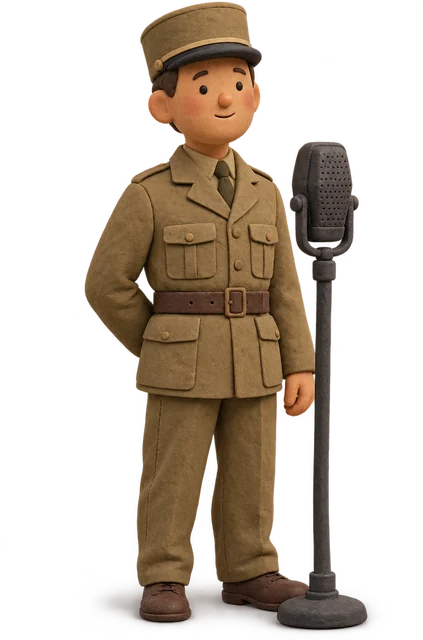
A French general and politician who called for resistance from London in 1940 and led Free France. After the war he founded the Fifth Republic in 1958 and became president.
What if everyone accepted a ceasefire and you cried out to keep fighting? De Gaulle was a general who called for resistance from London, England, in 1940 and led Free France. After the war he founded the Fifth Republic and served as president. He showed courage and responsibility together.
More detail
Two sources checked
What kind of person says "no" alone when everyone accepts a ceasefire? Charles de Gaulle was born in 1890 in Lille into a family of teachers. He graduated from the Saint-Cyr military academy, and in World War I he was wounded near Verdun and taken prisoner. Between the wars he argued that a new army built around tanks was needed.
In June 1940, as under-secretary of state for defense, he opposed the ceasefire and crossed over to London. To him, stopping the fight may not have been the end. On June 18 he called for resistance on BBC radio, and he led Free France. After the liberation of Paris in 1944 he became head of the provisional government and created women's suffrage and a social security system. But in January 1946 he clashed with the political parties and stepped down.
In the Algerian crisis of 1958 he was called back and became prime minister. He wrote the constitution of the Fifth Republic and became president in 1959. In 1962 he accepted Algeria's independence through the Evian Accords, and in 1963 he signed the Elysee Treaty with Germany. He also followed an independent foreign policy that kept some distance from the United States.
But after he got through the May 1968 movement, another test came. When he lost the 1969 referendum on reforming local government, he resigned on his own. Today it would be like a class president who gives up his seat because he lost a class vote. He died in 1970 at his home in Colombey-les-Deux-Eglises.
A voice that stood up to the end when everyone gave up, and a figure who accepted the vote and stepped down. These two scenes tell us today that courage and responsibility are needed together.
Life timeline
- 1940Appeal of 18 June; leads Free France
- 1944Head of the provisional government
- 1946Resigns from the provisional government
- 1958Becomes prime minister and drafts a new constitution
- 1959Takes office as president
- 1969Loses a referendum and resigns
Related events
- 1940De Gaulle's Appeal of 18 June and Free France
- 1940The Resistance and the National Council of the Resistance
- 1944Liberation of Paris
- 1944Women's Suffrage and the First Vote
- 1954Algerian War
- 1958Constitution of the Fifth Republic and de Gaulle
- 1958The Sudanese Republic Gains Self-Rule
- 1960Independence of the African Colonies
- 1962Évian Accords and Algerian Independence
- 1963Élysée Treaty (Franco-German Reconciliation)
- 1968The 68 Movement (May 1968)