 BETA
Person
Alexander Fleming
1881–1955 · Bacteriologist · United Kingdom
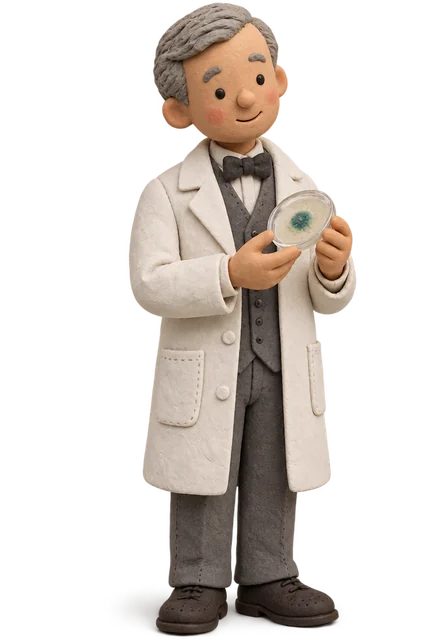
The bacteriologist who discovered penicillin.
Fleming discovered penicillin, a substance from mould that kills bacteria. Penicillin became the first antibiotic and saved countless people. That is why he won the Nobel Prize.
More detail
Two sources checked
Alexander Fleming was born in 1881 on a farm in Scotland. He worked as a clerk in a shipping company in London, then received an inheritance and entered the medical school of St Mary's Hospital.
In the First World War, seeing soldiers dying from wound infections in a military hospital, he researched ways to kill bacteria. In 1928 he discovered penicillin from the blue-green mould that had grown on a laboratory dish.
Penicillin was made into a medicine in the 1940s and saved countless lives, and in 1945 he received the Nobel Prize in Physiology or Medicine together with Florey and Chain. He died in 1955. He also warned early that if antibiotics are used too much, bacteria can become resistant.
Life timeline
- 1928Discovered penicillin
- 1945Awarded the Nobel Prize in Physiology or Medicine