 BETA
Person
Isaac Newton
1643–1727 · Scientist and mathematician · Kingdom of England
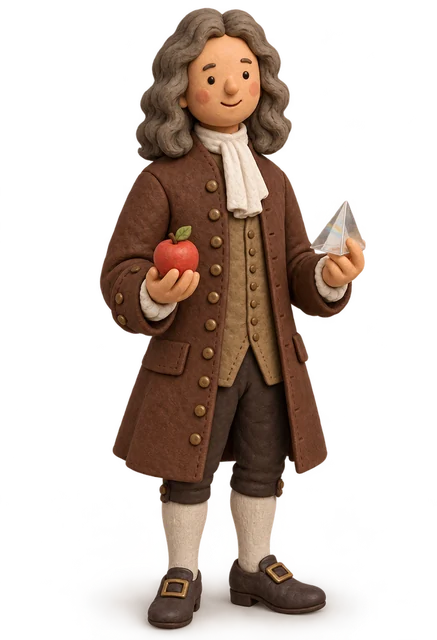
Isaac Newton, born in 1643, developed his research at his home village when a plague closed his university, and in the Principia in 1687 he explained the laws of motion and universal gravitation with mathematics, laying the foundation of modern science. He died in 1727 and was buried in Westminster Abbey.
Newton was the scientist who showed that the force that makes an apple fall and the force that keeps the Moon circling Earth are the same. When a plague closed his university, he developed his research at home, and he also found that sunlight splits into many colors. In his book of 1687 he explained universal gravitation with mathematics and laid the foundation of modern science. His life shows the power of following curiosity all the way.
More detail
Two sources checked
Would you believe that the force that makes an apple fall and the force that keeps the Moon circling Earth are the same? The person who showed this with mathematics was Isaac Newton. He was born in 1643 (1642 by the calendar of the time, on Christmas Day) in a small village in Lincolnshire. His father had died before he was born. Later he studied at the University of Cambridge.
Then something unexpected happened. In 1665-1666 a plague closed the university. School suddenly stopped, and Newton stayed at home and grew his ideas about calculus, the nature of light and gravity. It was a bit like a long vacation in which a project you dug into all by yourself leads to a great discovery. With a prism he showed that sunlight splits into light of many colors, and he also built a reflecting telescope.
Then in 1687, in the Principia, he explained the laws of motion and universal gravitation with mathematics. It is the book that showed that the movements of the heavens and the movements on Earth can be understood by the same laws.
Newton served as Master of the Royal Mint, where he cracked down on counterfeit money, and from 1703 he was president of the Royal Society. He died in 1727 and was buried in Westminster Abbey.
Newton's life tells us that break time can become thinking time, and that if you follow the question “why?” all the way, the world looks different.
Life timeline
- 1665Studied gravity and light at home
- 1696Began work at the Mint
- 1703Became President of the Royal Society