 BETA
Person
Alan Turing
1912–1954 · Mathematician and computer scientist · United Kingdom
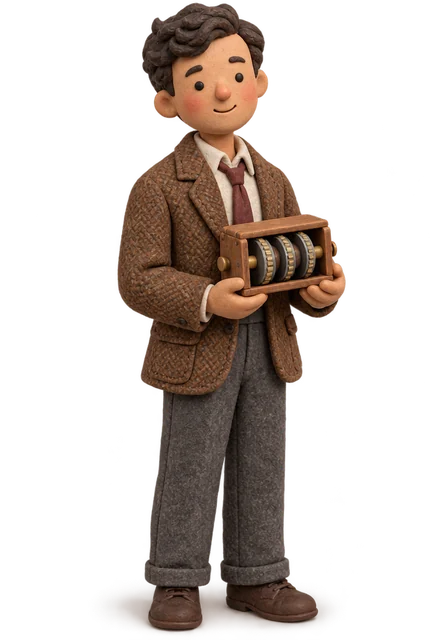
The mathematician who broke the German codes and is called the 'father of computer science.'
Turing was a mathematician who built a machine to break the Germans' secret codes. He was also the first to think of the ideas that today's computers are based on. That is why he is called the 'father of computer science.'
More detail
Two sources checked
Alan Turing was born in London in 1912. He studied mathematics at Cambridge, and in 1936 he thought up an imaginary machine that could carry out any calculation, the 'Turing machine'. This is the theoretical basis of today's computer.
During the Second World War, at Bletchley Park, he designed the machine called the 'Bombe' for breaking the German Enigma code and contributed greatly to the Allied victory.
After the war he designed an early computer and proposed the 'Turing test', which asks whether a machine can think. In 1952 he was convicted under a law under which homosexuality was a crime, and he died in 1954. In 2009 the British prime minister officially apologized, and from 2021 his face has appeared on the 50-pound note.
Life timeline
- 1936Published the 'Turing machine'
- 1939Began work at Bletchley Park
- 1950Proposed the 'Turing test'