 BETA
Person
Plato
428 BCE–348 BCE · Philosopher of ancient Greece · Athens
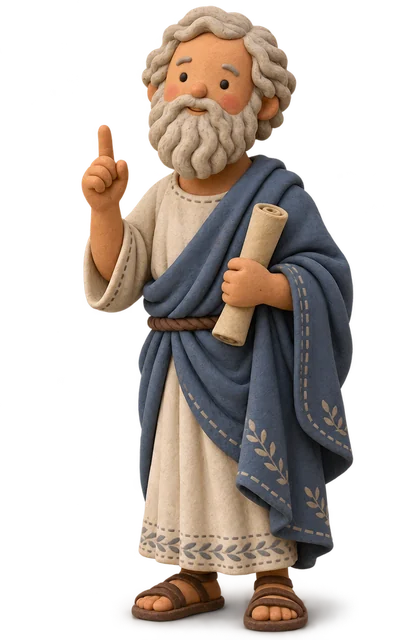
Plato was born around 428/427 BCE into a noble family of Athens. After seeing his teacher Socrates put to death, he chose philosophy over his dream of being a statesman. Around 387 BCE he founded the Academy, and in the Republic he described the Ideas and a state ruled by philosophers through the Allegory of the Cave, laying the foundation of Western philosophy.
What did a young man choose after watching his teacher be put to death? Plato chose philosophy over his dream of being a statesman and founded a school, the Academy, in Athens. He went to Sicily three times to try to build a state ruled by a philosopher, but failed. He left his conversations with his teacher in books and described the Ideas and an ideal state. His influence was so great that people say Western philosophy is "a series of footnotes to Plato."
More detail
Two sources checked
What did a young man choose after seeing his teacher put to death? Plato was born around 428/427 BCE into a famous noble family of Athens. At first he meant to become a statesman, but in his late twenties he saw his teacher Socrates executed and chose the path of philosophy.
Afterward he traveled to southern Italy and Sicily, where he met the Pythagoreans, and around 387 BCE he founded the Academy in Athens. He went to Sicily three times to try to turn the king of Syracuse into a philosopher-king, but failed. It is as if you visited one student three times to make him a model pupil and it still did not work.
He left behind some 30 dialogues in which Socrates is the main character. In the Republic he explained the Ideas with the Allegory of the Cave, in which a person who has only seen shadows in a cave comes outside and sees the sun. It is like watching only videos on a screen and then seeing real sunlight outside for the first time. He also described a state ruled by wise philosophers.
The British philosopher Whitehead said that Western philosophy is "a series of footnotes to Plato." Plato's question, do not trust only what you see in front of you, but think more deeply, reaches us today too.
Life timeline
- 399 BCEDeath of his teacher Socrates
- 387 BCEFounds the Academy
Related events
- 399 BCETrial and Death of Socrates
- 387 BCEPlato's Academy