 BETA
Person
Ashoka
?–232 BCE · King of the Maurya Empire · Maurya Empire
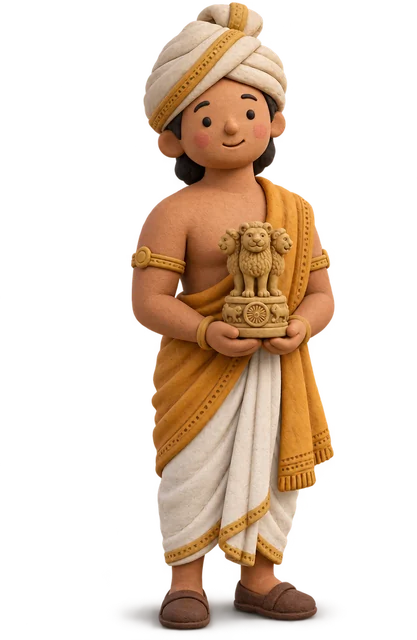
The third king of the Maurya Empire, who became a deep believer in Buddhism after the Kalinga War. He carved edicts about respect for life and religious tolerance on rocks and stone pillars and tried to rule by dharma (the right law).
How can a powerful king change? Ashoka, king of the Mauryas, became a Buddhist after the Kalinga War and carved edicts about respect for life and religious tolerance on rocks and stone pillars. In 1915 an edict with the name "Ashoka" was found, and his identity was confirmed. He was a king who regretted war and tried to rule by the right law.
More detail
Two sources checked
Would you believe that a single stone with a name carved on it revealed who a king really was? Ashoka was the grandson of Chandragupta, and he became the third king of the Maurya Empire.
The big turning point for him was the Kalinga War. After seeing the horrors of this war, Ashoka became a deep believer in Buddhism. We cannot know in detail how he felt about the war inside, but his actions afterward can be seen as showing his change. Perhaps it was only after winning so hard that he realized victory is not everything.
Ashoka had edicts carved on rocks and stone pillars all over his empire. They carried the message to treasure life and to respect other religions. It is like posting class rules not just on your classroom wall but on bulletin boards all over the country, so that everyone can read them.
In the edicts he called himself "Beloved of the Gods, Piyadasi." So for a long time people wondered who this name belonged to. Then in 1915 an edict that carried the name "Ashoka" was found, and it was confirmed that Piyadasi was Ashoka himself.
However, scholars disagree on some dates: his accession is placed around 270 to 268 BCE, his coronation around 269 to 265 BCE, and his death around 232 BCE. So some things are still not certain.
The story of a king who won by force, regretted the war, and tried to rule with law and tolerance makes us think, even today, about what real strength is.
Related events
- 265 BCE'Ashoka's Hell' and the Story of Ashoka's Conversion
- 261 BCEAshoka's Kalinga War
- 260 BCEAshoka's Rock and Pillar Edicts and the Lion Capital of Sarnath
- 250 BCEAshoka's Dharma Envoys and the Spread of Buddhism Abroad (Sri Lanka and the Hellenistic World)
- 250 BCEThe Building of the Great Stupa at Sanchi and Its Carved Toranas (Gateways)