 BETA
Person
Hammurabi
?–1750 BCE · King of Babylon · Old Babylonian Kingdom
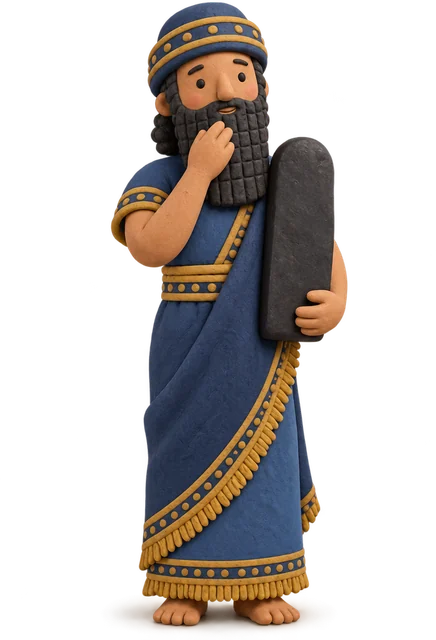
Around 1792 BCE he became the sixth king of Babylon and ruled for about 43 years. He united Mesopotamia and had the 282 laws of the Code of Hammurabi carved on a stele. Thanks to his unification, Babylon was the central city for more than a thousand years, but after his death the kingdom shrank again.
How could the king of a middle-sized state bring Mesopotamia together? Hammurabi, the sixth king of Babylon, waited for nearly 30 years while strengthening his own kingdom, then defeated Larsa and Mari and united Mesopotamia. Late in life he had 282 laws carved on a stone pillar. After his death the kingdom shrank, but Babylon stayed a central city for more than a thousand years.
More detail
Two sources checked
How could the king of a middle-sized state bring all of Mesopotamia together? Hammurabi was the son of Sin-muballit. Around 1792 BCE he became the sixth king of Babylon and ruled for about 43 years. At that time Babylon was a middle-sized state among strong states such as Larsa, Eshnunna, Mari and Assyria.
From his point of view, rushing would have been dangerous. So for nearly the first 30 years he strengthened his kingdom by digging canals and building temples and walls, and he waited for his time, making and breaking alliances with neighboring kings. It is like a team in a class competition that builds up its strength while waiting for a chance.
In 1763 BCE he defeated Rim-Sin of Larsa, and in 1761 he attacked Zimri-Lim of Mari, his long-time ally. He also took Eshnunna and the north, and united Mesopotamia. Some sources date the conquest of Mari to 1762.
Late in life he had 282 laws carved on a basalt stele and set up. At the top of the stele is a carving of him receiving kingship from Shamash, the god of justice. Many letters he sent to provincial officials also survive, and they show he was a careful king who looked after everything himself, from cleaning canals to trials.
Thanks to his unification, Babylon became the central city of Mesopotamia for the next thousand years and more. But after his death the kingdom shrank again. The laws carved in stone still show us today that rules set down for all to see can last a long time.
Life timeline
- 1792 BCEBecomes king of Babylon
- 1763 BCEConquers Larsa
- 1761 BCEConquers Mari
Related events
- 1763 BCEHammurabi Unites Mesopotamia
- 1754 BCECode of Hammurabi