 BETA
Person
Darius I
550 BCE–486 BCE · King of the Achaemenid Dynasty · Achaemenid Persia
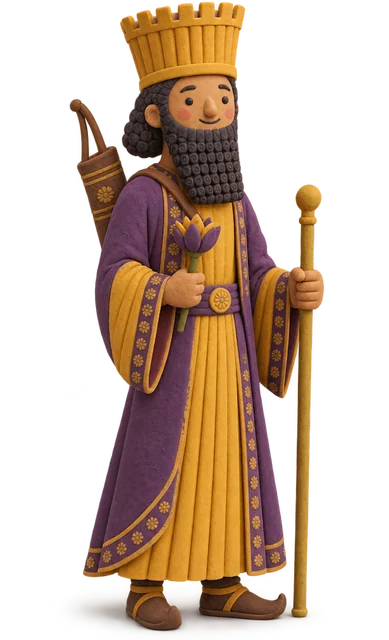
Darius I became king in the turmoil of 522 BCE, put down the rebellions, divided the empire into provinces, built the Royal Road, and founded Persepolis, shaping the framework of the Persian Empire. His campaign against Greece failed at Marathon.
How could one person rule such a huge empire? Darius I became king in the turmoil of 522 BCE, put down the rebellions, and divided the empire into provinces to rule it. He also made the Royal Road, which ran from Susa to Sardis, and the palace city of Persepolis. His campaign against Greece failed at Marathon, but the framework he built held the empire together for a long time. It shows that making rules and roads becomes a strength that protects a country.
More detail
Two sources checked
How could one person rule such an enormous empire? Darius I came from a distant branch of the Achaemenid family and took the throne in the turmoil of 522 BCE. So he was not a king everyone accepted from the start.
So first he had to get past the crisis. In a little over a year, he wrote in the Behistun inscription, he fought nineteen battles and crushed the rebellions. To Darius, the way to bring peace to this land was probably, first of all, to bind the shaky country into one.
After that, he built the framework of the state. He divided the empire into provinces and sent satraps (governors) to them, and put taxes and coinage in order. He built the Royal Road from Susa to Sardis. It is a bit like a very large school that names a teacher in charge of each grade, sets the same rules and the same lunch fee for everyone, and then builds a hallway joining all the classrooms. He rebuilt the palace at Susa and founded Persepolis in Fars. He also widened the empire, to the Indus River valley in the east and to Thrace in the west.
But not everything went his way. His campaign against Greece failed at Marathon in 490 BCE. In 486 BCE, while preparing the next campaign, he died and was buried in a cliff tomb at Naqsh-e Rostam.
The story of Darius shows that the strength that protects a country comes not only from victory but also from building agreed rules and roads. His birth year (around 550 BCE) is an estimate based on Herodotus.
Life timeline
- 513 BCEScythian campaign
Related events
- 522 BCEDarius I Takes the Throne and Puts Down Revolts
- 520 BCECarving the Behistun Inscription
- 518 BCEThe Achaemenid Persian Conquest of Gandhara and the Indus Region
- 518 BCEBuilding Persepolis
- 518 BCERuling a Vast Empire with the Satrapy System
- 515 BCEMinting the Daric Gold Coin
- 500 BCEThe Persian Royal Road
- 492 BCEDarius's Expedition to Greece
- 490 BCEBattle of Marathon