
Person
Gaius Julius Caesar
100 BCE–44 BCE · Roman general and politician · Roman Republic
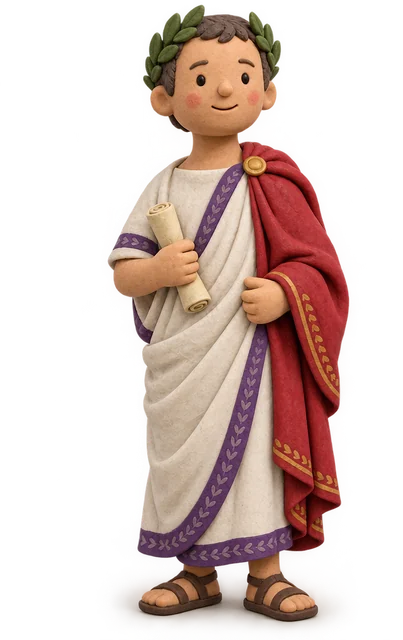
Caesar, a Roman general born around 100 BCE, gained power through his conquest of Gaul. In 49 BCE he crossed the Rubicon and started a civil war, became dictator and brought down the Republic, and was assassinated in the Senate on March 15, 44 BCE.
How did Caesar bring down the Roman Republic? After conquering Gaul and gaining power, he crossed the Rubicon in 49 BCE, started a civil war, and became dictator. He also created the Julian calendar, but he was assassinated in the Senate on March 15, 44 BCE. It is a story that makes us think about what happens when power gathers in one person.
More detail
Two sources checked
How did crossing one river change the fate of a nation? Caesar is generally thought to have been born in 100 BCE, though some say 102 BCE. He was a Roman general and politician, and by conquering Gaul (today's France) he gained enormous power.
The problem was that this power was too big. In today's terms, it is like a class president who holds the whole class's lunch-duty chart in his hands all by himself. Rome was a republic, ruled by many people sharing power, so seeing power gather in one man must have looked dangerous to others.
In 49 BCE, Caesar crossed the Rubicon and started a civil war. To him, the road forward may have seemed bigger than the road back. But from Rome's point of view, it was an army raised inside the country itself.
Having won the civil war, Caesar became dictator with no time limit. He also made the Julian calendar, with a year of 365 days and one extra day every four years. This amazing work became the basis of the calendar we use now. A man holding power could throw a country into chaos, and he could also change everyday life.
On March 15, 44 BCE, Caesar was stabbed 23 times in the Senate and killed. The man who brought down the Republic fell in the middle of the Republic. What happens when too much power gathers in one person, and how should that power be shared? We are asked to think about this even today, starting with deciding a single class rule.
Related events
- 88 BCEMithridates VI and the Wars with Rome
- 61 BCECaesar's Campaign in Lusitania and Olisipo
- 58 BCECaesar's Gallic Wars
- 55 BCECaesar's Bridge over the Rhine
- 55 BCECaesar's Expeditions to Britain
- 52 BCEBattle of Alesia and the Surrender of Vercingetorix
- 49 BCECaesar Crosses the Rubicon, the Civil War, and His Assassination
- 48 BCEBattle of Pharsalus
- 47 BCEThe Battle of Zela: "I came, I saw, I conquered"
- 46 BCEIntroduction of the Julian Calendar
- 44 BCEThe Assassination of Caesar in Shakespeare's Julius Caesar