 BETA
Person
Akiyama Saneyuki
1868–1918 · Naval Staff Officer · Empire of Japan
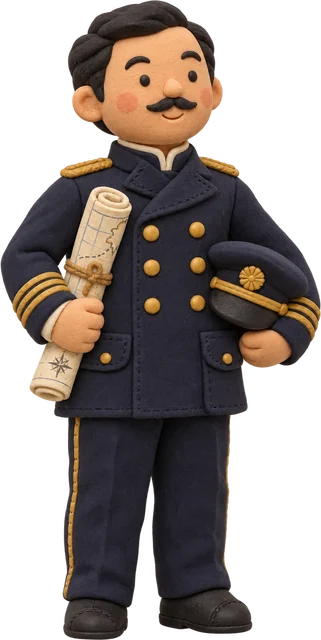
Akiyama Saneyuki, from Matsuyama, studied naval strategy in the United States. In the Russo-Japanese War he was an operations staff officer of the Combined Fleet and planned the tactics for the Battle of Tsushima. He was also known for his skill in writing telegram messages.
With what eyes did the staff officer who planned the operations read the sea? Akiyama Saneyuki learned naval strategy in the United States and planned the Combined Fleet's operations in the Russo-Japanese War. Even a single line of a telegram held the fate of thousands of people.
More detail
Two sources checked
With what eyes did the staff officer who drew up operations read the sea? Akiyama Saneyuki was born in 1868 into a samurai family of the Matsuyama domain. His older brother Akiyama Yoshifuru later led the army cavalry, and his friend was the poet Masaoka Shiki.
After graduating from the Naval Academy and taking part in the Sino-Japanese War, he studied in the United States in 1897. At the US Naval War College he studied the theories of the naval strategist Mahan and military history, and also observed the Spanish-American War. After returning he taught strategy and tactics as an instructor at the Naval War College, and the theory he built there is said to have become the foundation of the Japanese navy.
When the Russo-Japanese War broke out in 1904, he became operations staff officer of the Combined Fleet and assisted Togo Heihachiro at his side. He drew up the blockade operations to close Port Arthur and the concrete plans for the Battle of Tsushima against the Baltic Fleet. It is told as a famous story that he put the words 'the weather is fine but the waves are high' into the telegram reporting the battle. After the war the story that the 'T-crossing tactic' was his plan spread widely, but there is also research saying this is weakly grounded.
He later rose to vice admiral and died in 1918 at the age of forty-nine.
His story shows how heavy the staff officer's responsibility is when a single map and a single line of telegram decide the fate of thousands at sea.
Life timeline
- 1892Naval sub-lieutenant
- 1894Takes part in the Sino-Japanese War
- 1897Studies in the United States and learns from Mahan
- 1904Operations staff officer of the Combined Fleet in the Russo-Japanese War
- 1905In charge of operations at the Battle of Tsushima
- 1917Vice admiral
- 1918Dies