 BETA
Person
Anami Korechika
1887–1945 · Army General and Army Minister at the End of the War · Empire of Japan
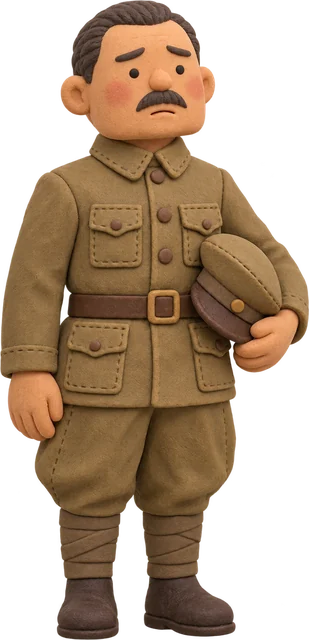
The Army Minister who argued for fighting to the end, but once the emperor's decision came, he prevented a military revolt, and after signing the surrender document he took his own life in the early morning of August 15, 1945.
How did the Army Minister act at the moment the war ended? Anami Korechika argued for fighting to the end, but when the emperor's decision came, he told the soldiers to follow orders and prevented a revolt. After signing the surrender document, he took his own life in the early morning of August 15. His story shows that one person's choice can prevent great chaos.
More detail
Two sources checked
Caught between the words "the war must be ended" and the feeling that it could not be ended, what choice did the man who represented the army make? Anami Korechika was an army officer from Oita Prefecture who served as aide-de-camp to the emperor and commanded troops on the China front and the Pacific front. In April 1945 he became army minister in the Suzuki cabinet.
Even after the bomb fell on Hiroshima on August 6 and the Soviet Union entered the war, he insisted on a decisive battle on the home islands. He confronted Foreign Minister Togo, saying, "We cannot accept a surrender with no guarantee of protecting the kokutai (the emperor system)." On August 10 the emperor chose the foreign minister's proposal, but he kept adding conditions in the meetings that followed.
On the night of August 13, young officers asked him to carry out a "military coup." He hesitated, but a senior general opposed it, and at the final Imperial Conference on the 14th he is said to have wept when the emperor persuaded him personally. After that he ordered the army to "obey the imperial rescript without fail," and held down the hard-liners.
After countersigning the surrender rescript, he left a note, "By my death I atone for my great crime," and took his own life in the early morning of the 15th.
Anami was not so much a man who hastened peace as the face of an army that dragged the war out to the end, who at the last moment restrained the army and prevented a revolt. His story makes us reflect on how much one person's choice can prevent or bring about.
Life timeline
- 1887Born in Oita
- 1929Became aide-de-camp to the emperor
- 1941Became commander of the 11th Army and fought in China
- 1944Became inspector general of aviation
- 1945Became army minister
He took office in April. - 1945Insisted on conditions to the very end at the Imperial Conferences
It was August 9-14. - 1945Took his own life
It was the early morning of August 15.