 BETA
Person
Asanuma Inejiro
1898–1960 · Chairman of the Socialist Party · State of Japan
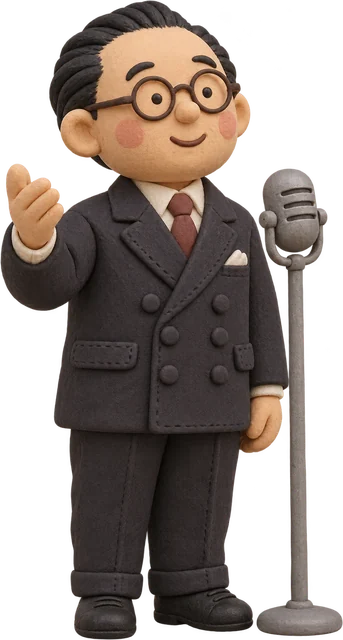
Asanuma Inejiro started a construction workers' union and joined the socialist movement, and became chairman of the Socialist Party in 1960. In the heat of the Anpo struggle, he was killed by a right-wing youth during a speech on October 12, 1960.
What should people do when discussion with words loses its power? Asanuma Inejiro, as chairman of the Socialist Party, stood in the middle of the Anpo struggle and was killed by a right-wing youth during a speech in October 1960. This event was a great shock. It reminds us that violence cannot be justified even when opinions differ.
More detail
Two sources checked
When debate with words seems weaker than a blade, what choice should people make? Asanuma Inejiro was born on December 27, 1898 (some sources say December 2), on Miyakejima in Tokyo. In 1919 he founded the Kensetsusha Domei (Builders' League) and threw himself into the socialist movement, and in 1923 he graduated from the Faculty of Political Science and Economics at Waseda University.
In 1925 he became secretary-general of the Farmer-Labor Party, but it was soon ordered to dissolve. In 1926, as head of the organization department of the Labor-Farmer Party, he led the Kizaki Village tenant farmers' dispute in Niigata Prefecture. In 1936 he became a member of the House of Representatives, and in 1943 he served as vice chairman of the Tokyo Metropolitan Assembly.
After the war, in 1948, he became secretary-general of the Japan Socialist Party, and in March 1960 he rose to chair. This was a time when large protests were continuing across the country over the revision of the U.S.-Japan Security Treaty.
On October 12, 1960, while giving a speech at Hibiya Public Hall in Tokyo, he was stabbed by a right-wing youth and died. The incident was also broadcast on television and gave a great shock to Japanese society.
He had to lead the Socialist Party through a difficult period in which protests and parliamentary debate were intertwined. After his death, discussion continued about the safety of political leaders and society's responsibility to stand against violence.
His death tells us today that violence cannot be justified even when political opinions differ. In today's terms, it is like how a class meeting should not settle a difference of opinion with fists.
Life timeline
- 1898Born on Miyakejima, Tokyo
December 27 (some sources say the 2nd). - 1919Founded the Kensetsusha Domei
He took part in the socialist movement. - 1923Graduated from Waseda University
The Faculty of Political Science and Economics. - 1926Led the Kizaki Village tenant farmers' dispute
He was head of the organization department of the Labor-Farmer Party. - 1936Elected to the House of Representatives
He took the path of a politician. - 1948Secretary-general of the Japan Socialist Party
He became a core figure of the postwar Socialist Party. - 1960Became chair of the Socialist Party
In March. - 1960Assassinated at Hibiya Public Hall
October 12.