 BETA
Person
Daughter of Sugawara no Takasue
1008–? · Woman writer of the Sarashina Diary · Japan (Ritsuryō State)
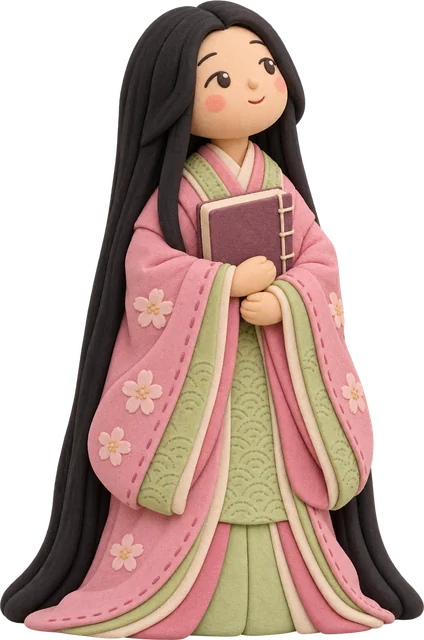
The daughter of Sugawara no Takasue was a writer who left the Sarashina Diary. At thirteen she came up from Kazusa to the capital, and the diary looks back on her childhood passion for the Tale of Genji, her marriage, her husband's death and her lonely later years.
What kind of adult did a girl who loved books become? The daughter of Sugawara no Takasue came to the capital at thirteen and fell in love with the Tale of Genji. When she grew up, she lived through marriage and her husband's death and wrote the Sarashina Diary, looking back on her life. An ordinary person's heart has reached us to this day.
More detail
Two sources checked
There was a girl a thousand years ago, too, who stayed up all night over a book. Born in 1008, this woman was a daughter of Takasue, a fifth-generation descendant of Sugawara no Michizane. Her mother was a half-sister of the mother of Fujiwara no Michitsuna, who wrote the Kagero Nikki, so literature ran in the family.
At thirteen, when her father's term ended, she traveled up from Kazusa Province to the capital, and later put the scenery she saw on the road and what she felt into her diary. When the girl arrived in the capital, she is said to have received the Genji Monogatari (The Tale of Genji) from her aunt, read it, and become completely absorbed. In today's terms, she is like a girl binge-reading a fantasy novel series in one go.
As an adult, at about thirty she became a lady-in-waiting serving Princess Yushi, and the next year she married Tachibana no Toshimichi. The dreamlike life she had imagined did not come, and her husband died. The diary holds the feelings of her old age, regretting that she had been so absorbed in stories that she neglected her Buddhist faith.
In writing this diary she looked back on the distance between her childhood dreams and reality. Writing was probably her way of meeting past time again. The Hamamatsu Chunagon Monogatari and the Yoru no Nezame are also said to have been written by her.
Her writing is close to readers today because it is the voice of an ordinary person who loved books and felt regret as she grew old. Isn't it amazing that the joy of reading books was the same a thousand years ago?
Life timeline
- 1008Born
- 1020At thirteen, travels up to the capital from Kazusa Province
- 1039Around this time begins working as a lady-in-waiting (estimated)
- 1040Around this time marries Tachibana no Toshimichi (estimated)
- 1058Her husband dies (estimated)
- 1060Around this time writes the Sarashina Nikki (estimated)