 BETA
Person
Eisai
1141–1215 · Zen monk who brought the Rinzai school · Kamakura Shogunate
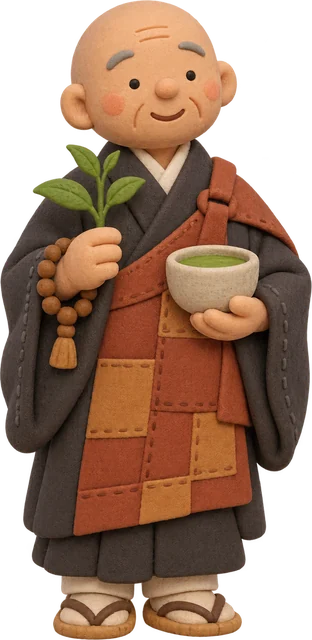
He was a monk from a Shinto priest family in Okayama who crossed to Song China twice. In 1191 he brought Rinzai Zen to Japan and built temples in Kamakura and Kyoto. He also left the Kissa Yojoki (Drinking Tea for Health), which describes the benefits of tea, and spread tea culture in Japan.
How did tea become part of Japanese culture? Eisai crossed to Song China twice, brought back Rinzai Zen, and built Kenninji. He also wrote a book about the benefits of tea. Thanks to him, the culture of enjoying tea continues today.
More detail
Two sources checked
Where did the custom of drinking tea in temples begin? Eisai was born into the family of the Kibitsu Shrine in Okayama and received the precepts on Mount Hiei at fourteen. At first he studied esoteric Buddhism and Tendai, but his wish to see Chinese Buddhism with his own eyes grew.
He went to Song China for the first time in 1168 and returned, and in 1187 he crossed again and studied Zen under the Linji school monk Xuan'an Huaichang. After he returned in 1191 and spread Zen in Kyushu, the monks of Mount Hiei objected. In 1198 Eisai wrote the Kozen Gokoku Ron (Treatise on Promoting Zen for the Protection of the Country) and answered back that "Zen is a Buddhism that protects the country."
In Kamakura he received support from Hojo Masako and Shogun Yoriie. He founded Jufuku-ji in 1200 and Kennin-ji in Kyoto in 1202. Kennin-ji was a training hall that taught Tendai, esoteric Buddhism, and Zen together. Eisai was a pioneer who rooted Zen in Japan's warrior society.
In 1211 he wrote the Kissa Yojoki (Drinking Tea for Health), and it is also told that in 1214 he offered tea to Shogun Sanetomo, who was sick from drinking, and it worked. He died in 1215.
Eisai also stressed that monks keep the precepts and rules. Because he explained Zen not as practice of merely sitting quietly but as a way to protect the country and govern the mind, the warrior government probably found it easy to accept his teaching.
It is interesting that one of the roots of the green tea and tea ceremony that Japanese people enjoy today is Eisai's writing. A monk who recommended tea for health ended up changing culture.
Life timeline
- 1141Born in Bitchu (Okayama)
- 1168Went to Song China for the first time
- 1187Crossed to Song again and studied Linji Zen
- 1191Returned to Japan
- 1198Wrote the Kozen Gokoku Ron
- 1202Founded Kennin-ji in Kyoto
- 1211Wrote the Kissa Yojoki
- 1215Died