 BETA
Person
Fukui Kenichi
1918–1998 · Chemist and Nobel Prize in Chemistry winner · State of Japan
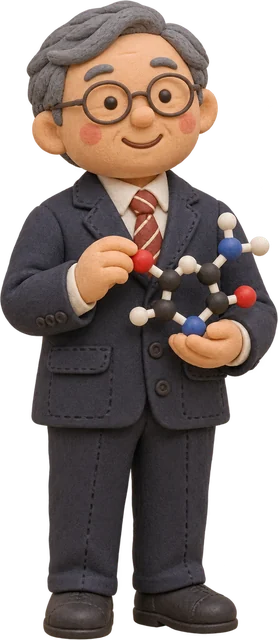
At Kyoto University, Fukui Kenichi published the "frontier electron theory" in 1952, which says chemical reactions are decided by the movement of electrons. For this he received the Nobel Prize in 1981, Japan's first in chemistry.
Why do chemical reactions go only in certain directions? At Kyoto University, Fukui Kenichi published in 1952 the "frontier electron theory," which says the outermost electrons decide the direction of a reaction, and he received the Nobel Prize in Chemistry in 1981. It was not easily accepted at first, but it became a foundation of chemistry. The curiosity that looks for rules in an invisible world is used in today's new medicines and materials.
More detail
Two sources checked
Why do chemical reactions occur only in certain directions? Fukui Kenichi was born in Nara in 1918. He graduated from the Department of Industrial Chemistry, Faculty of Engineering, Kyoto Imperial University in 1941, became a lecturer in the Department of Fuel Chemistry at the same university in 1943, became an associate professor in 1945, and received a doctorate in engineering in 1948.
Becoming a professor in 1951, he published his first paper on "frontier electron theory" the next year, 1952. It is the idea that the outermost electrons in a molecule decide the direction of a reaction. It was not easily accepted at first, but later, interlocking with other researchers' theories, it is said to have become an important foundation of chemistry.
He received the Japan Academy Prize in 1962, and in 1981 shared the Nobel Prize in Chemistry with Roald Hoffmann of the United States. In the same year he also received the Order of Culture. In 1982 he became president of Kyoto Institute of Technology (Kyoto Kogei Sen'i University), and in 1988 director of the Institute for Fundamental Chemistry, raising younger researchers.
He died in January 1998 at the age of 79.
His theory was later used as a guide for researchers designing new drugs and new materials, to gauge which molecules to bring together and how. Turning the world of invisible electrons into pictures in the mind was his life's work.
In today's terms, it can be explained by the analogy that the runner at the front of a race decides the direction of the finish line. The curiosity that tried to find rules in the movements of invisible electrons is also being used in today's development of new drugs and materials.
Life timeline
- 1918Born in Nara
October 4. - 1941Graduated from the Department of Industrial Chemistry at Kyoto Imperial University
Walked the path of a scientist-engineer. - 1948Doctor of Engineering
Continued research at Kyoto University. - 1951Professor at Kyoto University
Led a laboratory. - 1952Published frontier electron theory
His first paper. - 1981Nobel Prize in Chemistry, Order of Culture
Shared with Roald Hoffmann. - 1988Director of the Institute for Fundamental Chemistry
Guided younger researchers' work. - 1998Died
January 9, at the age of 79.