 BETA
Person
Hata no Kawakatsu
active 603–644 CE · Head of the Hata clan and close aide of Prince Shotoku · Wa (Yamato Court)
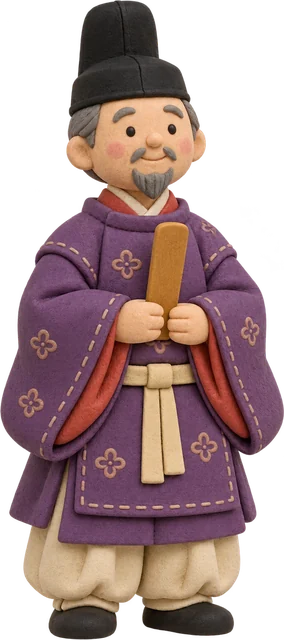
He was the head of the Hata clan, a family of immigrant descent, who is said to have received a Buddha statue from Prince Shotoku and built Koryu-ji at Uzumasa in Kyoto. He handled military supplies and the reception of foreign envoys, and tradition also links him to the roots of Noh.
Who was the head of a family with skills that came from the Korean peninsula? Hata no Kawakatsu received a Buddha statue from Prince Shotoku and built a temple in Kyoto. He is also said to have welcomed envoys and helped with supplies. Later stories made him an ancestor of Noh, but that part is closer to legend. He shows how technology from neighbors took root in Japanese culture.
More detail
Two sources checked
In a family with the skills of silk and waterways, who was the most trusted person? Hata no Kawakatsu was a central figure of the Hata clan, known as descendants of people who came from the Korean Peninsula. His birth and death years are not known, but he is thought to have been active in the first half of the 7th century in the time of Empress Suiko.
According to the Nihon Shoki, in 603, when Prince Shotoku offered to give a Buddha image to his ministers, Kawakatsu received it and built a temple. This is said to be Hachioka-dera in Kadono, Yamashiro, which later became Koryu-ji in Uzumasa, Kyoto. Receiving the image meant being trusted by the prince.
He also became involved in politics and military affairs. He is said to have helped with supplies in the fight against Mononobe no Moriya and to have received envoys from Silla and Imna in 610. A record also says that in 644 he put down a group who were bewitching people by claiming to worship the god of Tokoyo. In today's terms, he is like a dependable friend who takes charge of supplies and guiding at school events.
In later times more stories were added. The Noh theory book Fushikaden writes that Prince Shotoku had Kawakatsu create sarugaku, and there is also a legend that he crossed the sea and was enshrined at the Osake Shrine in Harima. These may be less fact than stories by performing families seeking to establish their ancestor's authority. The musicians of Shitenno-ji are also said to have taken him as their ancestor.
Kawakatsu shows how skills and people from the Korean Peninsula took root in Japanese society. That one family's skill and trust reached to temples, performing arts and even today's Kyoto scenery recalls the gift left by exchange with neighbors.
Life timeline
- 603 CEReceived Prince Shotoku's Buddha image and built a temple
A Nihon Shoki date; there is also a theory of 622. - 610 CEReceived envoys from Silla and Imna
He is said to have handled diplomatic practice. - 622 CEAnother theory about the founding year
There is a theory that Koryu-ji was founded in 622. - 644 CEPut down a group that worshiped the god of Tokoyo
An entry in the Nihon Shoki. - 1400Tradition of being the founder of sarugaku recorded in the Fushikaden
A story from a performing-arts theory book written in later times.