 BETA
Person
Honami Koetsu
1558–1637 · Calligrapher, potter and crafts director · Edo Shogunate
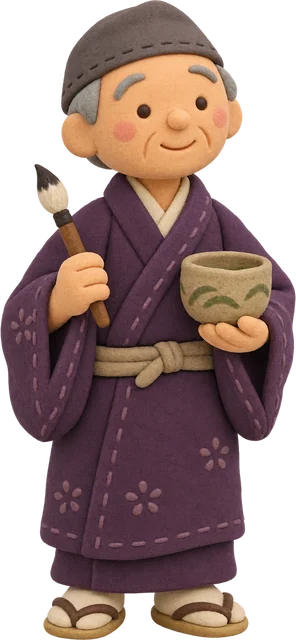
Born into a family of sword appraisers, he excelled at calligraphy, lacquerware and pottery, and in 1615 he received land from Ieyasu and founded an artists' village at Takagamine.
Why did someone from a family of sword appraisers found an art village? Koetsu excelled at calligraphy, lacquerware and pottery, and in 1615 he formed an artists' village at Takagamine. One person's taste helped culture grow.
More detail
Two sources checked
How did a man from a family of sword appraisers come to found an artists' village? Hon'ami Koetsu was born in Kyoto in 1558 into a family that appraised and polished swords. He carried on the family line as an adopted heir, but it is said that when a son was born to the main house, he left and founded a separate household.
Koetsu was especially gifted at calligraphy and is counted among the "Three Brushes of the Kan'ei era." He is said to have learned the tea ceremony from Furuta Oribe. The lacquerware he designed came to be called "Koetsu maki-e," and his tea bowl "Mount Fuji" and the "Funabashi Inkstone Box" are National Treasures today.
He recognized the talent of the painter Tawaraya Sotatsu and worked with him. The scrolls on which Koetsu wrote the calligraphy over Sotatsu's underdrawings survive as treasures of Japanese art. They are a good example of group work, where two talents met and produced something new.
In 1615 Ieyasu granted him land at Takagamine, north of Kyoto. There Koetsu built a village of artists together with relatives, craftsmen, and fellow believers of the Lotus (Hokke) sect. He died in Kyoto in 1637, at nearly eighty. The sharp eye of a family that polished and appraised swords is said to have carried over into his sense for choosing bowls and calligraphy.
Koetsu's village later led to the painting style called Rinpa. It shows that one person's taste can gather many craftsmen and grow a new culture.
Life timeline
- 1558Born in Kyoto
- 1600Active in Kyoto from the end of Hideyoshi's time into the early Edo period
This was the period when he became known for calligraphy and crafts. - 1615Received land at Takagamine and built an artists' village
- 1624Called one of the Three Brushes of the Kan'ei era from around this time
This refers to the Kan'ei era (1624-44). - 1637Died in Kyoto