 BETA
Person
Ishiwara Kanji
1889–1949 · Staff officer of the Kwantung Army and mastermind of the Manchurian Incident · Empire of Japan
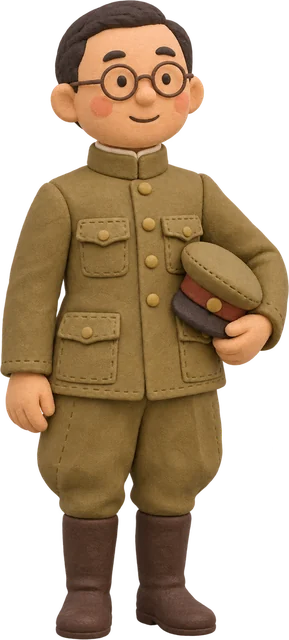
A staff officer of the Kwantung Army, he set off the Manchurian Incident in 1931 and created Manchukuo. He later opposed the widening of the Sino-Japanese War, clashed with Tojo Hideki and left the army as a lieutenant general.
Who started the Manchurian Incident? An officer named Ishiwara Kanji moved the army without the government's permission and took Manchuria. But this success became a bad example for other soldiers, and when the Sino-Japanese War grew, he himself opposed it, quarreled with Tojo Hideki and was pushed out of the army. This story shows that breaking the rules without being punished can grow into even bigger wrongs.
More detail
Two sources checked
If an officer started a war without the government's permission and was not punished, what did the other officers learn from it? Ishiwara Kanji was an army man from Yamagata Prefecture who became a staff officer of the Kwantung Army in 1928 and thought that Manchuria should be made Japan's lifeline.
He was drawn to a faith in the Buddhist Nichiren tradition, and while studying European military history in Germany he came to believe that future wars would be total wars that poured out all of a nation's strength. So he put forward his "final world war theory": first take Manchuria and build strength, and some day fight a last war with the United States, the representative of the West.
In September 1931, together with Itagaki Seishiro and others, he moved the army using the bombing of a railway near Liutiaohu as a pretext, and the next year Manchukuo was founded. The government and the General Staff could not stop this, and the success became a bad example inside the army: "even if you are told to stop from above, you can just push ahead." In the February 26 Incident of 1936, Ishiwara also took the lead in putting down the rebel troops.
But when the Sino-Japanese War broke out in 1937, he opposed it, saying "we must not expand further," and was pushed aside; in Manchuria he fell out with the chief of staff Tojo Hideki and withdrew to the reserves in 1941. After the war he was not indicted as a war criminal, and it is said that he proudly stated that the Manchurian Incident was his own doing.
His story is not that of a pacifist who stopped war, but that of a man who himself opened the door to aggression and later feared that the door had grown too large. It is also a mirror showing what happens when a person who broke the rules is rewarded.
Life timeline
- 1922Went to Germany and studied total war
- 1928Became a Kwantung Army staff officer
- 1931Started the Manchurian Incident
He moved the army using the bombing of the Liutiaohu railway as a pretext. - 1932Founding of Manchukuo
- 1936Took part in putting down the February 26 Incident
- 1937Opposed the expansion of the Sino-Japanese War
- 1941Withdrew to the reserves
He left the army after a clash with Tojo Hideki. - 1949Died