 BETA
Person
Ito Hirobumi
1841–1909 · First prime minister and first Resident-General of Korea · Empire of Japan
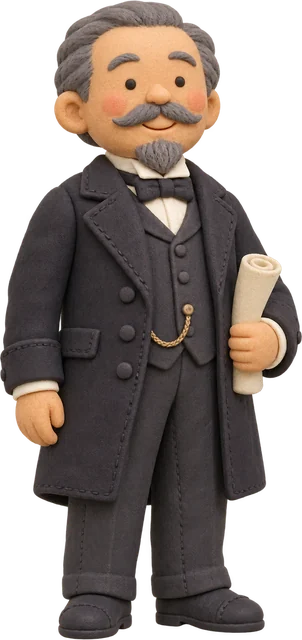
Born in Choshu, Ito Hirobumi saw Western institutions in Britain. He became the first prime minister in 1885 and drew up the constitution of 1889. Later, as Resident-General of Korea, he led Japanese rule there, and in 1909 he was killed by Ahn Jung-geun in Harbin.
How did a poor country boy become the nation's first prime minister? Ito Hirobumi saw the West in Britain, became the first prime minister in 1885, and made the constitution in 1889. But later he became Resident-General of Korea and led Japanese rule there, and in 1909 he was killed by a shot from Ahn Jung-geun. Remember that one person's great achievements can still be a source of pain for neighbors.
More detail
Two sources checked
How did a boy from a poor farming family become his country's first prime minister? Ito Hirobumi was born in 1841 in the countryside of the Choshu domain (today's Yamaguchi Prefecture) and gained lower-samurai status by following his adoptive father. In his youth he is said to have joined the "expel the foreigners" movement and even taken part in burning the British legation.
But in 1863 he secretly went to study in Britain, and after seeing warships and factories with his own eyes, his thinking changed completely. He came to believe that the country should not shut its doors but learn from the West and catch up. When the Meiji government was set up, he, who could speak English, soon became a useful talent, and in 1871 he toured the United States and Europe as deputy envoy of the Iwakura Mission.
In the 1880s he became the person in charge of writing what we might call the "country's operating manual." After studying constitutions in Germany and Austria and returning, he created the cabinet system in 1885 and became the first prime minister, and in 1889 the Constitution of the Empire of Japan was promulgated. This constitution was a compromise that gave the emperor great powers while still setting up a parliament. He served as prime minister four times afterward, and in 1900 he created a political party (the Rikken Seiyukai) and stepped into party politics as well.
His name remains a painful one for Koreans. In 1905, after the Russo-Japanese War, a treaty was concluded that took away the Korean Empire's diplomatic rights, and Ito came in 1906 as the first Resident-General and held sway over its internal affairs. In Japan he is honored as the "architect of modern Japan," but in Korea he is remembered as a leader of the invasion. In October 1909 he was shot dead by An Jung-geun at Harbin Station, and the next year the Japanese government annexed the Korean Empire.
The fact that one person did both the work of framing a country and the work of taking away a neighboring country's sovereignty makes people remember the same history differently even today. That is why we need to look at the memories of both countries.
Life timeline
- 1863Secretly went to study in Britain
He crossed over as one of five young men from Choshu. - 1871Deputy envoy of the Iwakura Mission
- 1885First prime minister of the cabinet
- 1889Constitution of the Empire of Japan promulgated
He led the drafting of the constitution. - 1900Founded the Rikken Seiyukai
- 1906First Resident-General of Korea
He took up his post in Korea after the 1905 treaty. - 1909Died at Harbin
He was killed by An Jung-geun's gunshots.
Related events
- 1871The Iwakura Mission
- 1885Creation of the Cabinet System
- 1889Promulgation of the Constitution of the Empire of Japan
- 1890Opening of the First Imperial Diet
- 1894First Sino-Japanese War and the Treaty of Shimonoseki
- 1906Establishment of the Japanese Resident-General of Korea
- 1910Annexation of Korea (Japanese Side)