 BETA
Person
Emperor Keitai
?–531 CE · 26th emperor · Wa (Yamato Court)
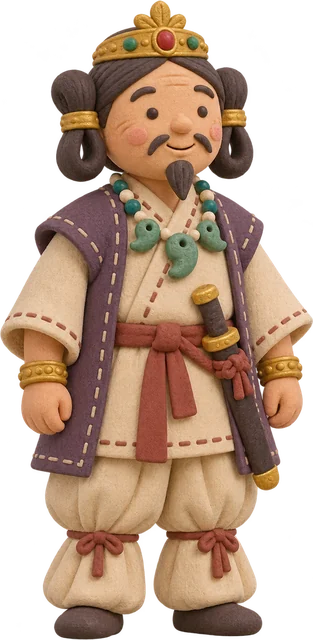
He was an emperor of the early 6th century who is said to have been brought in from the Echizen and Omi region by the Yamato court after the line of heirs ran out. Some say the royal line changed with him. Amid the Iwai Rebellion and worsening events on the Korean Peninsula, he settled his palace in Yamato after 20 years.
When no one was left to take the throne, the court searched far away for a royal family member and brought him in. That man was Emperor Keitai. Because he came from a distant region, he moved his palace several times after taking the throne and settled in Yamato after 20 years. He also faced the Iwai rebellion in Kyushu and changes on the Korean Peninsula. His story shows that a job given suddenly can still be carried on if you slowly win people's hearts.
More detail
Two sources checked
When there was no one to succeed to the throne, whom did the court go out to find? According to the Nihon Shoki, when Emperor Buretsu died in 507 without an heir, ministers such as Otomo no Kanamura and Mononobe no Arakahi brought a royal from far away. He was the 26th emperor, Emperor Keitai.
His home differs by source. Some say he came from Mikuni in Echizen, today's Fukui Prefecture, and others say he was born in Omi, today's Shiga Prefecture, and raised in his mother's home of Echizen. Because a royal from a distant province became king, some scholars see it as a change of the royal bloodline. Others, on the contrary, see it as merely a collateral royal taking over.
It is said that he could not enter Yamato right away. After taking the throne at the Kusuha Palace in Kawachi, he moved his palace around to Tsutsuki and Otokuni in Yamashiro, and only about 20 years into his reign did he settle at the Iware Tamaho Palace in Yamato. In today's terms, it is like a transfer student who moved seats all semester to win his classmates' hearts. Having become king unexpectedly, he must first have had to balance the clans within the court.
During his reign outside affairs were also hard. On the Korean Peninsula, the situation of Baekje and Gaya was changing quickly, and a record remains that four counties of Imna passed to Baekje. In 527 Iwai, a chief of Kyushu, rose in revolt and a great battle took place, and the next year Mononobe no Arakahi is said to have put it down. It was a time when royal power was shaken both inside and out.
Emperor Keitai is said to have died in 531, but there are also records of 527 or 534. His tomb is set as Mishima no Ai no mausoleum in Ibaraki, Osaka Prefecture. How a man made king in haste carried on the state gives us something to think about today, resembling an organization with a vacancy worrying about whom to entrust it to.
Life timeline
- 507 CEBuretsu died and he was chosen as heir
The year of accession in the Nihon Shoki. - 511 CEMoved among several palaces
He is said to have passed through the Kusuha Palace, Tsutsuki, Otokuni and others. - 527 CEIwai's Rebellion in Tsukushi
A large rebellion that broke out in Kyushu. - 528 CEPut down Iwai's rebellion
He is said to have sent Mononobe no Arakahi. - 531 CESaid to have died
There are also theories of 527 and 534.