 BETA
Person
Kitabatake Chikafusa
1293–1354 · Thinker of the Southern Court · Kenmu Government
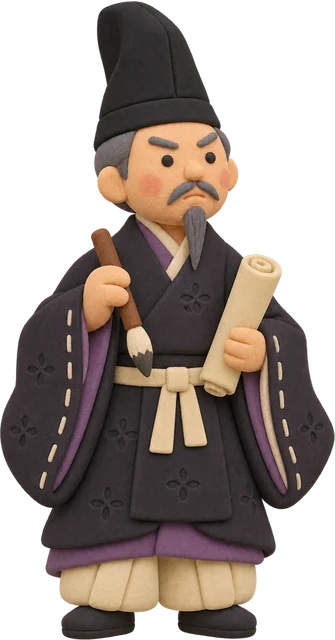
A retainer of Emperor Go-Daigo, he defended the Southern Court after the death of his son Akiie, and in 1339 wrote the Jinno Shotoki (Records of the Legitimate Succession of the Divine Emperors) to argue that the Southern Court was the rightful one. He was a noble.
If there are two kings, which is the real one? Chikafusa, at the center of the Southern Court, wrote the Jinno Shotoki and argued that the Southern Court was the rightful one. This book explains Japanese history around the line of emperors. It is still read as an example of how the reading of history changes with each age.
More detail
Two sources checked
If there are two kings, which one is the real one? Kitabatake Chikafusa came from a noble family and won the trust of Emperor Go-Daigo. He was put in charge of educating the emperor's son, Prince Seira, but when the prince died young he became a monk.
In 1333 he went to Mutsu with his eldest son Akiie, and when his son died in battle in 1338 he became the center leading the Southern Court. In the autumn of 1338 he headed for the eastern provinces with a large fleet, but it was scattered by a storm; he landed in Hitachi and tried to gather Southern Court forces at Oda Castle and Seki Castle.
In the middle of the war Chikafusa wrote the Jinno Shotoki (Records of the Legitimate Succession of the Divine Sovereigns). This book argues that what makes Japan special is that the line of emperors has continued unbroken since the age of myth, and it tries to explain that the Southern Court's emperor is the legitimate one. It is also said to have been written for the young Emperor Go-Murakami.
But in the eastern provinces the Southern Court's strength weakened. Around 1343 Chikafusa returned to Yoshino and helped the Southern Court. He died in Yoshino in 1354.
In this book Chikafusa begins with the words "Great Japan is the land of the gods" and explains the imperial line. Because it had a strong intention to explain the rightness of his own side, it is read cautiously today as writing in which fact and argument are mixed.
The book was also used in later ages to support an emperor-centered view of history. It is a book that makes us think about how interpretations of history are used in each age.
Life timeline
- 1330Became a monk when Prince Seira died
- 1333Went down to Mutsu with his son Akiie
- 1338His son Akiie died in battle
- 1339Wrote the Jinno Shotoki
- 1343Returned to Yoshino
- 1354Died in Yoshino