 BETA
Person
Kitasato Shibasaburo
1853–1931 · Bacteriologist · Empire of Japan
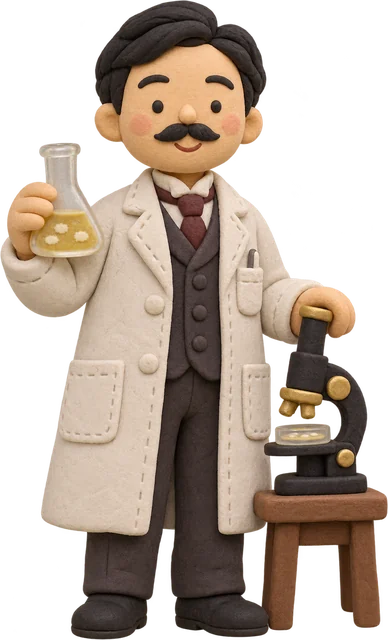
From a village head's family in Kumamoto, Kitasato Shibasaburo succeeded in 1889, under Robert Koch in Germany, in growing a pure culture of the tetanus bacillus. The next year he opened the way to serum therapy. After returning to Japan he founded the Institute for Infectious Diseases and the Kitasato Institute.
Why was it so hard to grow disease-causing germs on their own? In Germany in 1889, Kitasato Shibasaburo grew tetanus bacteria and opened the way to serum therapy. After returning home he founded institutes and trained many students. Today's vaccines and antibody treatments are an extension of that work.
More detail
Two sources checked
Why was it so hard to grow disease-causing bacteria on their own? Kitasato Shibasaburo was born in 1853 in the house of a large village head in Kumamoto. Against his family's wish that he become a samurai, he chose medicine, graduated from the medical school of the University of Tokyo, worked at the Hygiene Bureau of the Home Ministry, and left to study in Germany in 1886.
In Berlin he studied under Robert Koch, a master of bacteriology. The tetanus bacillus dislikes air and grows mixed with other bacteria, so it was very hard to grow on its own, but in 1889 he succeeded in obtaining a pure culture of it. The next year, together with Behring, he announced serum therapy for tetanus and diphtheria. It was the discovery that antibodies in the blood of a diseased animal can cure another animal.
When he returned in 1892, the Japanese academic world did not easily accept him. At this time Fukuzawa Yukichi provided a site for a laboratory, and the Institute for Infectious Diseases was founded. In 1894, when plague spread in Hong Kong, he went with the investigating team and found the bacterium. Yersin discovered the bacterium at the same time, and the argument over which of them was first continued.
But in 1914, when the government tried to move the institute under the Ministry of Education, he opposed it and resigned, and immediately founded the private Kitasato Institute. Talents such as his pupils Shiga Kiyoshi and Hata Sahachiro came from here. He died in 1931 and is also remembered as the first president of the Japan Medical Association.
A question that began in a corner of a laboratory became medicine that saved countless lives. Our use of vaccines and antibody treatment today is an extension of that research.
Life timeline
- 1886Studies in Germany under Koch
- 1889Succeeds in pure culture of the tetanus bacillus
- 1890Announces serum therapy with Behring
- 1892Returns home and prepares to set up the Institute for Infectious Diseases
- 1894Investigates the plague in Hong Kong
- 1914Leaves the Institute for Infectious Diseases and founds the Kitasato Institute
- 1931Dies