 BETA
Person
Komura Jutaro
1855–1911 · Foreign Minister and Diplomat · Empire of Japan
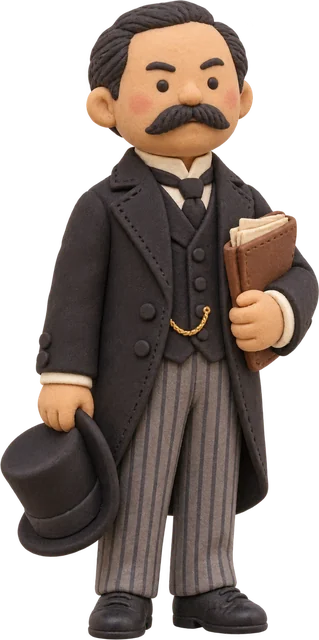
Komura Jutaro, from Miyazaki, led the Anglo-Japanese Alliance and the Treaty of Portsmouth, and in 1911 won back Japan's tariff autonomy. But he was also blamed by angry citizens because no war indemnity was received.
Why were people angry even though Japan won the war? Komura Jutaro made the Anglo-Japanese Alliance with Britain and, after the Russo-Japanese War, led the talks in Portsmouth in the United States. Citizens rioted because no war indemnity was paid, but in 1911 he also won back tariff autonomy. Sometimes ending a war is harder than winning it.
More detail
Two sources checked
If you won the war and people set fires over the result of the negotiations, how would the negotiator feel? Komura Jutaro was born in 1855 into a lower-samurai family of the Obi domain in Hyuga (today's Miyazaki Prefecture). A good student from a young age, he entered the University of Tokyo on the domain's recommendation and studied law at Harvard in the United States.
He joined the Foreign Ministry, worked in Beijing, Seoul and elsewhere after the Sino-Japanese War, and became foreign minister in 1901. At a time when Russia was building its strength in Manchuria, he chose the path of an alliance with Britain. With the Anglo-Japanese Alliance in 1902, Japan gained a solid backer against Russia.
As the Russo-Japanese War was drawing to a close in 1905, he sat down with Russia at Portsmouth in the United States as Japan's representative. Japan was running out of strength and could not drag things out. It won part of the land (southern Sakhalin) and a position of superiority in Korea, but received no war indemnity. Japanese citizens rioted in Hibiya, Tokyo, saying, "We won, so why is there no money?", and Komura's house also became a target of attack.
From his point of view, ending the war when Japan's national strength had reached its limit must have been the best course. Afterward he also took part in preparing the annexation of Korea, and in 1911 he concluded a new commercial treaty with the United States and regained the tariff autonomy that had been blocked until then. He died that same year.
A negotiation is judged only after it is over. The story of Komura tells us that "sometimes ending is harder than winning."
Life timeline
- 1875Studied law at Harvard University in the United States
- 1893Began working at the Foreign Ministry
- 1901Became foreign minister
- 1902Anglo-Japanese Alliance concluded
- 1905Delegate to the Portsmouth Peace Conference
The Hibiya Incendiary Incident occurred. - 1910Foreign minister at the annexation of Korea
His second term. - 1911Tariff autonomy regained; died