 BETA
Person
Kuratsukuri no Tori
active 606–623 CE · Buddha-statue sculptor (Tori Busshi) · Wa (Yamato Court)
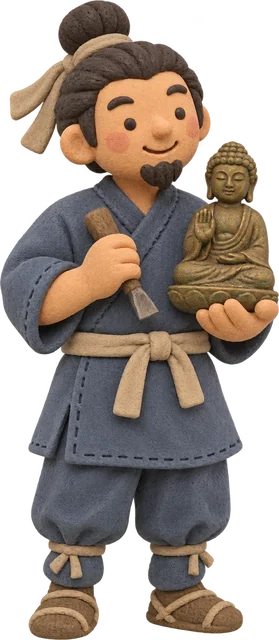
He was a sculptor of Buddha statues, a grandson of the immigrant Shiba Tatto. He is said to have made the gilt-bronze 16-foot main Buddha of Asukadera in 606 and the Shaka Triad in the main hall of Horyu-ji in 623. His name lives on in the Tori style.
Can a name carved into one Buddha statue last for 1,400 years? Kuratsukuri no Tori made the great Buddha of Asukadera in 606, and in 623 he finished the Shaka Triad of Horyu-ji for Prince Shotoku. His style, with a front-facing, quiet smile, is called the 'Tori style.' His work shows that prayer can last as beauty you can see.
More detail
Two sources checked
Can a name carved on a Buddha statue last fourteen hundred years? Kuratsukuri no Tori was a Buddha-statue sculptor of the Asuka period in the early 7th century. His father was Tasuna, and his grandfather Shiba Tatto is said to have been a toraijin (immigrant) who came from China. His was a family for which making Buddha images and building temples were one craft.
According to the Nihon Shoki, in 606, the 14th year of Empress Suiko, Tori made the main image of Asukadera, a gilt-bronze and embroidered Jōroku Buddha, that is, a large Buddha about 4.8 m tall. There is a record that he received rice fields in Sakata District, Omi, as a reward.
A clearer record is the Shaka Triad in the Kondo of Horyu-ji. According to the inscription on the back of the halo, in 622, when Prince Shotoku and his wife fell ill, his family and ministers decided to make a Shaka image as tall as the prince, and Tori completed it in 623, after both had died. It is in the "single halo triad" form, in which two bodhisattvas share a large halo around Shaka at the center.
Tori's Buddhas sit facing forward, with the robes spreading symmetrically left and right, and a faint smile; this is the Northern Wei style. Later it was called the "Tori style." In today's terms, it is a personality that you recognize at a glance, like one artist's handwriting.
Tori is the maker of a rare Buddha statue for which the year it was made, its story and its maker are all handed down together. That skill crossed the sea and became art in the hands of one family, and that prayer remains as form, tells us today why we should treasure cultural properties.
Life timeline
- 606 CEMade the Jōroku Buddha, the main image of Asukadera
It was the 14th year of Empress Suiko. - 606 CEReceived rice fields in Sakata District as a reward
A record in the Nihon Shoki. - 622 CEPrince Shotoku's illness and death; vow to make a Shaka image
His family and ministers decided to make an image as tall as the prince. - 623 CECompleted the Shaka Triad in the Kondo of Horyu-ji
It is inscribed on the back of the halo. - 1949Fire in the Kondo murals of Horyu-ji
The Shaka Triad in the same Kondo, a work of Tori, remains today.