 BETA
Person
Kuroda Seiki
1866–1924 · Western-Style Painter · Empire of Japan
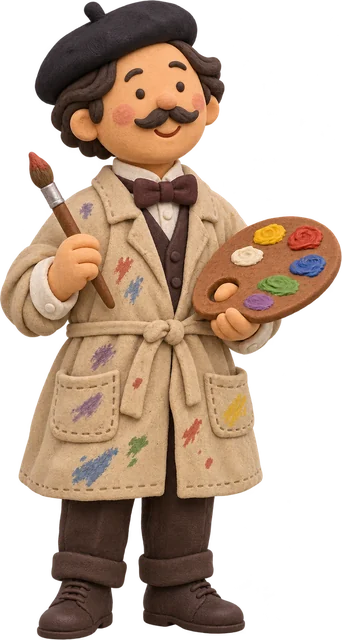
Kuroda Seiki, from Kagoshima, went to France in 1884 to study law but changed course to painting. His paintings of bright sunlight greatly influenced Western-style painting in Japan, and he led the Hakubakai group and the Bunten exhibition.
Why did a young man who went to study law pick up a brush? Kuroda Seiki learned in France how to paint bright sunlight and opened the way for Western-style painting in Japan. By founding the Hakubakai group and the Bunten exhibition, he helped a new kind of painting take root.
More detail
Two sources checked
Why did a young man who went to study law pick up a brush? Kuroda Seiki was born in 1866 into a samurai family of the Satsuma domain, was adopted by his uncle, and went up to Tokyo. In 1884, at eighteen, he crossed to France to study law, but his heart wavered as he met painters in Paris.
He set law aside and studied painting under the painter Raphael Collin. Collin was a 'plein-air' painter who depicted bright, soft sunlight, and Kuroda too learned to paint in bright colors instead of dark browns. When he returned in 1893, he brought this new kind of painting to Japan.
His paintings soon caused controversy as well. When he exhibited a work showing a nude body, it was condemned as 'harming public morals' and became an incident, and at one exhibition a cover was even put over it. But he was not shaken; he founded the Hakubakai (White Horse Society) in 1896, and the same year, when a Western painting department was created at the Tokyo School of Fine Arts, he became a professor.
In 1907 he created the government exhibition (Bunten) and led its judging, and in 1910 he became the first Western-style painter to be a member of the Imperial Art Academy (Teishitsu Gigeiin). In 1920 he became a member of the House of Peers, and he died in 1924 at the age of fifty-eight. His representative works are Dokusho (Reading), Maihime (The Dancer), and Kohan (Lakeside).
He was a person who made new painting take root in Japan through institutions and education. That current continues today when we paint landscapes in bright colors.
Life timeline
- 1884Studies in France
- 1893Returns home and introduces bright plein-air painting
- 1896Founds the Hakubakai; professor at the Tokyo School of Fine Arts
- 1907Creates the Ministry of Education art exhibition (Bunten)
- 1910First Western-style painter in the Imperial Art Academy
- 1924Dies