 BETA
Person
Maejima Hisoka
1835–1919 · Official and Father of the Modern Postal System · Empire of Japan
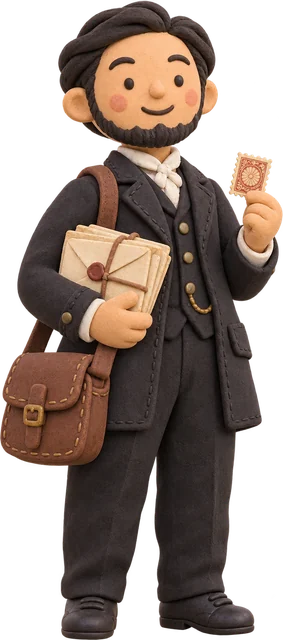
Born into a wealthy farming family in Echigo, Maejima Hisoka started the Tokyo-Osaka mail service in 1871 and founded the modern postal system. He even chose stamps, postcards and the name 'yubin' (mail), and also worked on telegraph and telephone services.
How inconvenient it would be if the price of a letter were different every time! In 1871 Maejima Hisoka started a modern postal service in which the price was set by distance and weight and a stamp was attached. Thanks to this, letters could be sent anywhere in the country. One small promise joined the nation together.
More detail
Two sources checked
What would it be like if sending one letter took several days and the price varied every time? Maejima Hisoka was born in 1835 into a wealthy farming family in what is today Niigata Prefecture, studied Western learning in Edo, and also opened his eyes to the work of ships sailing the seas. Later he became an adopted son in a family of shogunate retainers.
After coming to work in the Meiji government, he studied in Britain and then became director of the postal service (ekiteikami) and set out to create a postal system. At that time letters were carried by couriers, cheaply for nearby places and expensively for far ones, and the price was not fixed. He proposed introducing "a system in which, anywhere in the country, the price is set by distance and weight and a stamp is attached."
In 1871 the new mail began between Tokyo, Kyoto and Osaka, and the next year it spread across the country. He is known to have brought the words "yubin" (mail), "kitte" (stamp) and "hagaki" (postcard) into wide use. In 1873 Japanese mail was established as a national enterprise, and a few years later it joined international postal agreements.
After being pushed out of the government by the Political Crisis of Meiji 14 in 1881, he served as principal of the Tokyo Senmon Gakko (later Waseda University) and as president of a railway company. In 1888 he returned as vice minister of communications and worked to start the telephone business. He was also an unusual figure who put forward the opinion of reducing the number of kanji.
That we exchange a text message or a parcel today regardless of distance is because systems like this existed. A small promise linked up a whole country.
Life timeline
- 1869Planned the postal system in the Meiji government
- 1871Modern mail began
- 1872Mail extended nationwide
- 1881Left office in the Political Crisis of Meiji 14
- 1888Returned as vice minister of communications
He led the telephone business. - 1919Died