 BETA
Person
Motoori Norinaga
1730–1801 · Scholar of National Learning (kokugaku) · Edo Shogunate
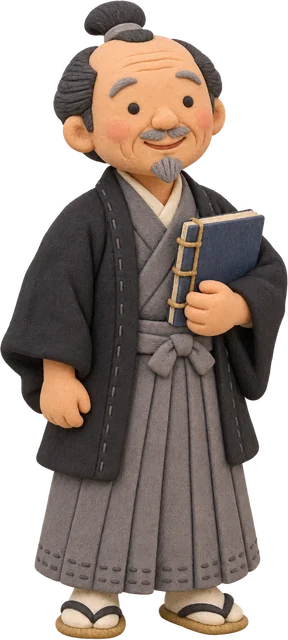
A doctor and scholar of Matsusaka who studied the Kojiki for more than 30 years and in 1798 completed the Kojiki-den (Commentary on the Kojiki) in 44 volumes. He was the great master of National Learning (kokugaku).
Who studied old Japanese among the sound of little bells? Norinaga worked as a doctor by day and dug into the Kojiki for more than 30 years, finishing the Kojiki-den in 1798. We should also think about how scholarship gets used in its time.
More detail
Two sources checked
There was a man who studied old Japanese amid the sound of bells. Who was he? Motoori Norinaga was born in 1730 in Matsusaka, Ise Province, into a merchant family.
In 1752 he went to Kyoto and studied medicine and Confucianism. In Kyoto he was also drawn to ancient Japanese poetry and The Tale of Genji, and became a doctor who also wrote poems. It is said that he received his medical license in 1755.
The decisive meeting came in 1763. He met the scholar Kamo no Mabuchi, who stopped in Matsusaka, became his pupil, and at Mabuchi's urging began reading the Kojiki. The Kojiki is an old book written in Chinese characters and hard to read, but Norinaga compared word after word and tried to bring ancient Japanese back to life. It was like a detective solving a strange ancient code one line at a time.
It is said that in 1782 he called his study "Suzunoya (House of Bells)" and liked to ring bells. In 1798, after 34 years, he completed the 44 volumes of Kojiki-den. He died in Matsusaka in 1801 at the age of seventy-two. A simple record also survives in his Kyoto travel diary, noting that he was amazed to see the Great Buddha of Hoko-ji.
His research later became an important basis for talking about Japanese identity. However, his thought was also used differently in politics later, so it should also be remembered that evaluations can change depending on how scholarship is used.
Life timeline
- 1730Born in Matsusaka
- 1752Went to Kyoto to study
- 1763Met Kamo no Mabuchi and became his pupil
- 1782Built his study Suzunoya and named it
- 1798Completed the 44 volumes of Kojiki-den
- 1801Died in Matsusaka