 BETA
Person
Nashime
active 239–247 CE · Himiko's envoy and a high official of Wa who received the title of a Wei general · Small States of Wa
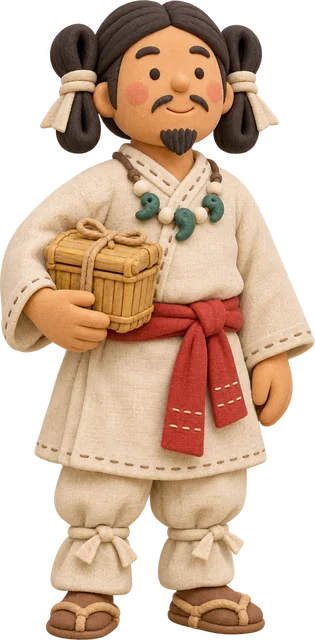
Nashime was the head of the first mission that Himiko sent to Wei around 239. He traveled through Daifang Commandery, south of Lelang, as far as the capital Luoyang, and received the title "Shuaishan Zhonglang Jiang" (a general's rank) and a silver seal. In 247 he received the yellow banner that Wei sent, which helped hold the country together during its fight with Kunu. He was a high official (taifu) of Wa.
Was there anyone who crossed the distant sea to meet an emperor? Nashime, a retainer of Himiko, went around 239 to the capital of Wei, offered gifts, and brought back a title and a silver seal. Later, when Wei sent a banner to support the fight against Kunu, he was the one who received it. One name has survived for more than a thousand years and still tells us today about the people who traded across the sea.
More detail
Two sources checked
How would it feel to be given the task of going across the sea to meet the emperor of a strange country? The Wei section of the Records of the Three Kingdoms, the account of the people of Wa, records Nashome (難升米; Nanshōme or Nashime in Japanese readings) as the Wa official who carried out that task. His post was "taifu," that is, a high minister at the king's side.
The time was the early third century, right after Wa, following long and great strife, had set up Queen Himiko. Himiko tried to join hands with the great Chinese state of Wei and get one step ahead of her neighbors, and her first messenger was Nashome. The record says that in the sixth month of Jingchu 2 (usually interpreted as 239) he reached Daifang Commandery on the Korean peninsula and asked to see the emperor, and the governor assigned officials and sent him on to Luoyang. What Wa offered was four male slaves, six female slaves, and two bolts of patterned cloth.
The emperor was greatly pleased. The edict says that Nashome was made "Shuaishan Zhonglang Jiang" (a general-rank title meaning roughly Colonel Who Leads the Good) and given a silver seal and a blue cord, and the deputy envoy Niuli was also granted a separate title. In today's terms, it is like a team representative who went to an overseas competition and brought back an official certificate and badge (this is an analogy). Himiko received the title "Qinwei Wawang" (Wa king friendly to Wei), a gold seal, and 100 bronze mirrors, and the person who carried these gifts back across the sea was also from this mission.
Nashome's name appears afterward as well. In Zhengshi 6 (245), Wei gave Nashome a yellow banner, to be handed over through Daifang Commandery, and in 247, when the fighting with Kunu had grown, the envoy Zhang Zheng came with an edict and the banner, gave them to Nashome, and urged people to calm down with a proclamation. What he himself did in this fighting is not in the record.
Nashome left no huge tomb or famous relic, but he is one of the few people of the Yayoi period whose name has come down clearly, character by character. Just as today we call someone who works abroad representing the country a diplomat, one name remains of a person who crossed the sea and became the face of the country 1,800 years ago.
Life timeline
- 239 CEFirst envoy to Wei
As the queen's envoy he went to Luoyang by way of Daifang Commandery. The record says Jingchu 2, usually read as 239. - 239 CETitle of Shuaishan Zhonglang Jiang and a silver seal
The Wei emperor gave Nashome a title, a silver seal, and a blue cord. - 240 CEWei envoys came to Wa
In Zhengshi 1, a Wei mission came to Wa with an edict, seals, and gifts. There is no direct record that Nashome received them. - 245 CEYellow banner granted
Wei decided to give Nashome a yellow banner and left it in the care of Daifang Commandery. - 247 CEZhang Zheng delivered the banner and proclamation
During the fighting with Kunu, the Wei envoy Zhang Zheng gave the banner and edict to Nashome and urged people to calm down with a proclamation.