 BETA
PersonLegend
Emperor Nintoku
active 400–430 CE · 16th emperor (traditional) · Wa (Yamato Court)
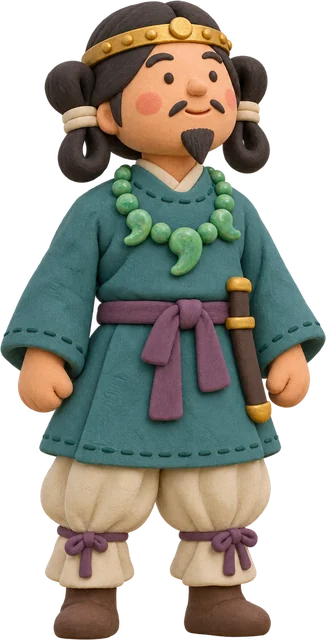
A king of 5th-century tradition. It is said that he saw no smoke rising from the kitchens of his people at Naniwa in Osaka and waived taxes for three years. Whether he was a real person, and whether he is the owner of the Daisen tomb mound, is still debated.
They say there was a king who saw a village where not one kitchen sent up cooking smoke. In the traditional story, Emperor Nintoku saw this and did not collect taxes for three years, and he made Naniwa a better place to live with banks and waterway works. Scholars are still arguing about whether he was a real king. Even so, people's fondness for a king who put his people first still feels warm today.
This comes from a legend. The story has been passed down from long ago, so we cannot know whether it really happened.
More detail
Two sources checked
When the king climbed a high place and looked down at the villages, what did he see that made his heart heavy? The old Japanese history books Kojiki and Nihon Shoki portray the 16th emperor, Emperor Nintoku, this way. He was the son of Emperor Ojin, and his name is said to be Osazaki. He is said to have ruled from the Takatsu Palace in Naniwa, which is today's Osaka.
According to the story, one day the king saw that not a single wisp of cooking smoke was rising from the villages. Feeling that the people were so poor they did not even have rice to cook, the king is said to have exempted them from taxes and labor service for three years, and not to have repaired even his own palace roof when it leaked. In today's terms, it is as if a class president announced, "I won't collect dues this month." There is also a story that three years later, when smoke rose from every house, the king was delighted. But this scene is very likely a heartwarming tale polished in later times.
There are also stories about how he came to the throne. After Emperor Ojin died, a record says that his half-brother Uji no Wakiiratsuko and he each yielded the throne to the other, and that he put down the rebellion raised by Oyamamori. Nintoku is also said to have carried out large works such as embankments, ponds and the waterways of Naniwa, which shows him trying to make land near the sea better to live in.
So Emperor Nintoku was long remembered as a model of the "benevolent ruler." But today's scholars think this name is a posthumous title given in the 8th century, and they consider the possibility that the same person as Emperor Ojin was handed down as two figures, or even that he did not exist at all. There is also a theory that he was San or Chin among the "Five Kings of Wa" in Chinese history books, but it has not been settled.
The Imperial Household Agency manages the huge Daisen Kofun in Sakai as the tomb of Emperor Nintoku. But some research says that the time the tomb was built does not match the era of the tradition. Whoever its real owner was, the hearts of the people who took a king worried about the cooking smoke of his people as an ideal still make us think today about "what is a good leader?"
Life timeline
- 400 CESaid to have ruled from the Takatsu Palace in Naniwa
Only estimated to be the first half of the 5th century; the exact year is not known. - 410 CEThe story of exempting taxes and labor service for three years
A tradition famous for the story of the people's kitchen smoke. - 415 CESaid to have carried out works on embankments, ponds and waterways
Recorded as improving the Naniwa area. - 420 CETheory linking him to San or Chin among the Five Kings of Wa in Chinese history books
Scholars have not reached a conclusion. - 430 CESaid to have died
A large tomb in the Mozu area is managed as his tomb. - 2019Mozu-Furuichi Kofun Group inscribed as a World Heritage Site
It includes the Daisen Kofun.