 BETA
Person
Nogi Maresuke
1849–1912 · Army general · Empire of Japan
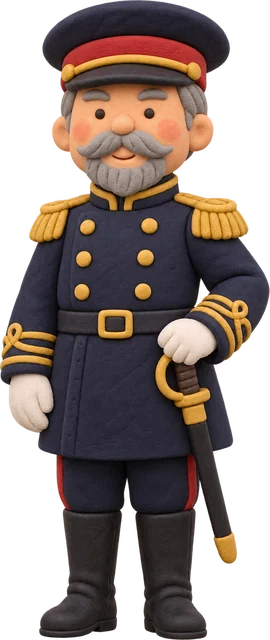
Nogi Maresuke, from the Choshu branch domain, led the Third Army in the Russo-Japanese War and took Port Arthur after heavy losses. He lost both of his sons, and on the day of Emperor Meiji's funeral in 1912 he died by junshi (following one's lord in death) together with his wife.
How would a general feel if he spent his whole life apologizing even after a victory? Nogi Maresuke captured Port Arthur in the Russo-Japanese War, but he lost many soldiers and both of his sons. On the day of Emperor Meiji's funeral in 1912, he died together with his wife. His story shows how far the wounds of war can follow one person through life.
More detail
Two sources checked
If there was a general who lived apologizing for the rest of his life even after victory, what was in his heart? Nogi Maresuke was born in 1849 into a samurai family of the Choshu branch domain (Chofu domain). As a child he dreamed of the path of a scholar but became a soldier, and it is said that in the Satsuma Rebellion (Seinan War) of 1877 he made a great mistake in having his regiment's flag taken by the enemy, and carried it as a burden on his heart for life.
In the Sino-Japanese War of 1894 he took Port Arthur (Lushun), and in 1896 he became governor-general of Taiwan but soon resigned. When the Russo-Japanese War broke out in 1904, he was given the mission, as commander of the Third Army, of attacking the Port Arthur fortress on Chinese soil. The Russian defense was firm and several assaults failed, and the Japanese army suffered enormous casualties. Nogi's two sons were also killed in this war. In the end they took 203 Meter Hill and the fortress fell, but the price was very high.
It is said that when he came home after the war, before people celebrating the victory he apologized to the parents of the dead soldiers. From 1907 he became head of the Gakushuin (the peers' school) and taught the young imperial grandson who would later become the Showa Emperor. It is said he was frugal and strict when teaching.
On September 13, 1912, the day of Emperor Meiji's funeral, he took his own life together with his wife Shizuko (junshi, following the lord in death). This was a great shock to Japanese society, and writers such as Mori Ogai and Natsume Soseki also left its influence in their works.
Some see his death as a symbol of loyalty, and others see it as the last form of an old custom. It tells us how the wounds left by war can drag along one person's life.
Life timeline
- 1871Becomes an army major
- 1877Has his regiment's flag taken in the Satsuma Rebellion
- 1894Takes part in the capture of Port Arthur in the Sino-Japanese War
- 1896Becomes governor-general of Taiwan
- 1904Commander of the Third Army in the Russo-Japanese War
- 1907Head of the Gakushuin
- 1912Dies by junshi with his wife on the day of Emperor Meiji's funeral