 BETA
Person
Nukata no Okimi
active 660–690 CE · Court woman poet · Wa (Yamato Court)
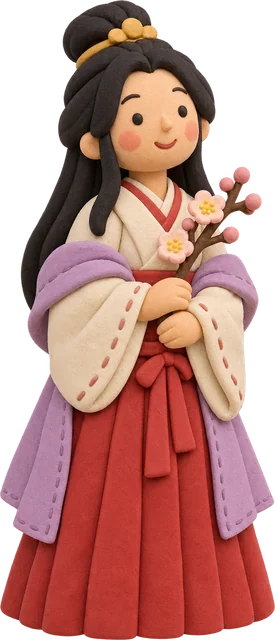
A woman poet who represents the early Man'yoshu. She composed poems at court events under Saimei and Tenji, and is said to have borne Princess Totochi to Tenmu. She is loved for her poem about spring and autumn competing and her poem about the purple fields.
Where was a song that has been loved for over a thousand years born? Nukata no Okimi was a woman poet of the Asuka period. She composed the purple field poem at a hunting ground, and Prince Oama sent a poem in reply. She also wrote the poem that sets spring against autumn. Her daughter, Princess Totochi, lost family in the Jinshin War, but Nukata no Okimi's poems are still alive today.
More detail
Two sources checked
In what setting was a love poem born that has been loved for more than a thousand years? Nukata no Okimi was a woman poet of the Asuka period. She was a daughter of Kagami no Okimi, and the years of her birth and death are not known. Most of the poems in the Man'yoshu from her time were composed in the reigns of Emperors Saimei and Tenji.
Her famous poem carries a story with it. On the 5th day of the 5th month of 668, when Emperor Tenji was enjoying a hunt at Kamono in Omi, she wrote a poem whose sense is: walking through the purple fields, I worry that someone will see you waving your sleeve. In reply, Prince Oama is said to have answered with a poem meaning: if I hated you, who are as lovely as the purple gromwell, would I love you, when you are another man's wife? She had once borne Princess Totochi to Prince Oama (later Emperor Tenmu), and is said to have later come to serve in Tenji's palace. So the exchange can be read as hinting at a love triangle, but there is also an interpretation that it was a game at a banquet. Today it may be closer to a joke exchanged in a class talent show.
Her poems were not only about love. There is an official-occasion poem contesting whether spring hills or autumn hills are more beautiful, and a poem sung as the ships set out at Nikitatsu during Empress Saimei's western expedition. Some poems are handed down in the name of the sovereign, so it is guessed that she sometimes composed poems on the sovereign's behalf.
Her daughter Princess Totochi married Prince Otomo, a son of Tenji. Otomo was defeated in the Jinshin War of 672 and took his own life, and Totochi died soon after. Behind one person's poems lay the story of a family caught up in a power struggle.
Nukata no Okimi shows how strong it can be to convey feelings in a few words. Just as hearts pass back and forth today through a single-line message, a poem from a thousand years ago is still alive.
Life timeline
- 661 CESaid to have composed a poem at Nikitatsu during Empress Saimei's western expedition
The year is an estimate matched to the expedition. - 668 CEPoem of the purple fields at the Kamono hunting ground
Prince Oama composed a reply. - 668 CEPoem contesting spring and autumn at the Omi court
Handed down as an official poem from Emperor Tenji's reign. - 672 CEHer son-in-law Prince Otomo died in the Jinshin War
Her daughter Princess Totochi also died soon after. - 672 CEPrince Oama won and became Emperor Tenmu
The year the Jinshin War ended.