 BETA
Person
Ogata Korin
1658–1716 · Leading Rinpa painter and craftsman · Edo Shogunate
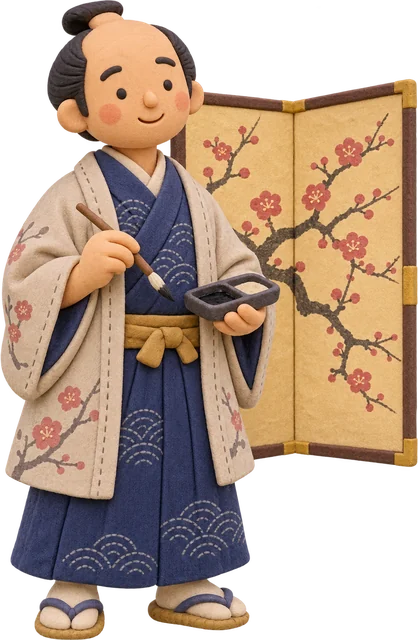
The son of a Kyoto textile merchant, he spent all his wealth and then devoted himself to painting from around age thirty. He received the rank of Hokkyo in 1701 and is famous for the Red and White Plum Blossoms screen and Irises.
How did a rich man's son who spent all his money become a master? Korin became a Hokkyo in 1701 and left bold designs such as Irises. His sense of design shows that new genres can be created even after failure.
More detail
Two sources checked
Would you believe that the son of a wealthy family who spent all his fortune became a giant of Japanese art history? Ogata Korin was born in Kyoto in 1658, the son of the high-end textile shop "Kariganeya." His younger brother was the potter Kenzan.
When his father died around the time Korin was thirty, he inherited a large fortune but is said to have spent it all within a few years, even borrowing money from his brother. He began painting in earnest around the age of forty, and it is said that money trouble was one reason he made painting his profession. It is like someone who builds real skill only after using up every item in a game.
In 1701, at the age of forty-four, he received the rank of Hokkyo. It is said that a noble patron helped him. From 1704 he stayed in Edo and worked for daimyo mansions, but life there is said to have felt stifling. In 1712 he returned to Kyoto and painted masterpieces of his later years.
His designs are bold and simple. His folding screen of irises lines up purple irises rhythmically against a golden background, and he also painted designs on pottery fired by his brother Kenzan. He died in Kyoto in 1716 at the age of fifty-nine.
Korin's art, which continued the tradition of Sotatsu and Koetsu, is called "Rinpa." The fact that taste and sensibility can create a new genre even through failure and debt gives courage to designers today as well.
Life timeline
- 1658Born in Kyoto
- 1687His father died and he inherited a large fortune
- 1701Received the rank of Hokkyo
- 1704Went to Edo and stayed there
- 1712Returned to Kyoto and painted masterpieces of his later years
- 1716Died in Kyoto