 BETA
Person
Otomo Sorin
1530–1587 · Kirishitan Daimyo of Bungo · Muromachi Shogunate
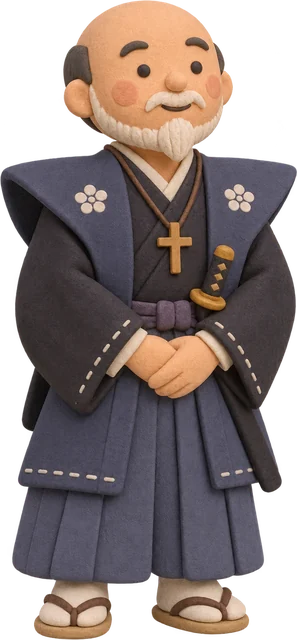
A daimyo of Bungo in Kyushu who accepted Nanban trade and Christianity and was baptized in 1578. But that same year he was badly defeated by the Shimazu army at the Battle of Mimikawa, and his power declined.
Was there a city where a church and trade grew together? Otomo Sorin welcomed missionaries to Funai and accepted trade and Christianity, and in 1578 he was baptized himself. That same year he was badly defeated at the Battle of Mimikawa and his power declined, but his story lives on.
More detail
Two sources checked
What was it like when a church and trade grew together in one city? Otomo Sorin was a daimyo of Bungo (Oita) in Kyushu, and his real name was Yoshishige. After his father Yoshiaki died, in 1550 he settled the succession question and led the family.
In 1551 Xavier came to Funai in Bungo and met Sorin. Sorin welcomed the missionaries because he aimed at trade with Portuguese ships. Funai flourished as a port of Nanban trade, and a church, a hospital and a school were built. At that time Sorin was not yet a believer.
Sorin widened his power in Kyushu and for a time ruled six provinces. But he lost his strength in 1578 in the Battle of Mimikawa, where he was badly defeated by the Shimazu army in Hyuga. In the same year he was baptized and received the baptismal name Francisco.
In 1586, when the Shimazu moved north, Sorin went to Osaka and asked Hideyoshi for help. This became the cause of the Kyushu campaign. In 1587 Sorin died at Tsukumi. The Tensho Boys' Embassy of 1582 is said to have been sent in Sorin's name, but it has been pointed out that the letter is a forgery.
Sorin was also a cultured man who enjoyed Zen and the tea ceremony. As for his reason for changing faith, there is both the view that it was for political and trade gain and the view that it was sincere.
Sorin's life shows that accepting new trade and religion was both an opportunity and a danger. Traces of Funai are still being excavated today in Oita City.
Life timeline
- 1550Settled the succession question and led the family
- 1551Received Xavier at Funai
- 1578Heavily defeated by the Shimazu at the Battle of Mimikawa
- 1578Was baptized
- 1586Went to Osaka and asked Hideyoshi for relief
- 1587Died at Tsukumi