 BETA
Person
Oyama Iwao
1842–1916 · Field Marshal and Commander-in-Chief of the Manchurian Army · Empire of Japan
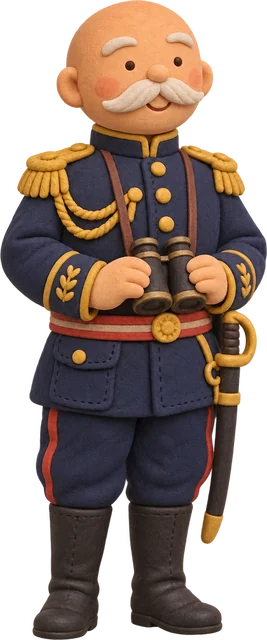
Oyama Iwao, from Satsuma, was a cousin of Saigo Takamori but sided with the government army in the Satsuma Rebellion. He built up the army and led Japan to victory as commander-in-chief of the Manchurian Army in the Russo-Japanese War in 1904.
How would it feel to face your close cousin with guns? Oyama Iwao fought his cousin Saigo Takamori in the Satsuma Rebellion, and in the Russo-Japanese War he led Japan to victory as commander-in-chief of the Manchurian Army. He had the strength to trust people and leave work in their hands.
More detail
Two sources checked
What would it feel like if the day came when you had to point guns at a close cousin? Oyama Iwao was born in 1842 into a samurai family of the Satsuma domain. He grew up following his older cousin Saigo Takamori, and in the war with Britain in 1863 he showed his skill in gunnery.
In 1870 he studied in France and personally observed the war between Prussia and France. After returning, he brought Western-style artillery and systems into the Japanese army. When the Satsuma Rebellion (Seinan War) broke out in 1877, his cousin Saigo rose against the government. Oyama fought on the government side, and it is said that this choice, holding a gun against Saigo, weighed on him heavily for life.
Afterward he served as army minister for a long time and built up the army, and in 1883 he married Oyama Sutematsu, who had finished studying in the United States. In the Sino-Japanese War he landed on the Liaodong Peninsula as commander of the Second Army, and in 1898 he became a field marshal. In the Russo-Japanese War of 1904 he became commander-in-chief of the Manchurian Army, and while Chief of Staff Kodama Gentaro actually led the operations, he is said to have made decisions at key moments and steadied the army. He was known as a relaxed leader who left things to his subordinates rather than shouting orders at the front.
After the war he became a prince (duke), and from 1914 he assisted the emperor as Lord Keeper of the Privy Seal, until he died in 1916.
The strength to trust people and entrust work to them, and the weight in the heart of having had to stand against a close person, were both together in one person.
Life timeline
- 1863Takes part in the Anglo-Satsuma War
- 1870Studies in France and observes the Franco-Prussian War
- 1877Commands government forces in the Satsuma Rebellion
- 1883Marries Oyama Sutematsu
- 1894Commander of the Second Army in the Sino-Japanese War
- 1904Commander-in-chief of the Manchurian Army in the Russo-Japanese War
- 1916Dies