 BETA
Person
Oyama Sutematsu
1860–1919 · First Female Student Abroad and Social Activist · Empire of Japan
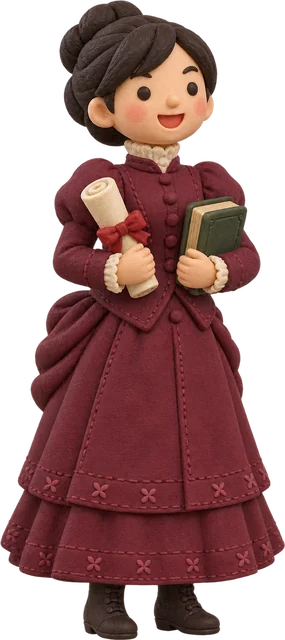
The daughter of a senior retainer (karo) of Aizu, Oyama Sutematsu went to the United States with the Iwakura Mission at the age of eleven and in 1882 became the first Japanese woman to receive an American college degree. After returning, she married Oyama Iwao, the Minister of the Army, and helped with high-society events and with nursing and education projects.
What courage would it take for an eleven-year-old girl to cross the sea and live abroad for ten years? Oyama Sutematsu went to the United States in 1871 and in 1882 became the first Japanese woman to receive an American college degree. After she came home, she helped with nursing and education projects. Her long road of learning opened the way for other women.
More detail
Two sources checked
If an eleven-year-old girl lived ten years across the sea alone, what kind of courage would she need? Oyama Sutematsu was born in 1860 into a chief retainer family of the Aizu domain. As a small child she went through the siege of Aizu Castle in the Boshin War, and her defeated family fell into great hardship.
In 1871 the Japanese government decided to send female students to the United States. With almost no volunteers and difficulties arising, Sutematsu was chosen together with Tsuda Umeko and others as among the youngest. A story is also told that her mother gave her the name "Sutematsu" with the meaning "I am sending you with the thought of giving up (sute) but will wait (matsu) for your return." She grew up in Connecticut under the care of an American family and graduated from Vassar College in 1882. It was the first American bachelor's degree received by a Japanese woman. She also obtained a nursing qualification.
After returning to Japan in 1882, though her Japanese was poor, she married Army Minister Oyama Iwao in 1883. In the Rokumeikan era, the center of Western-style socializing, she was active as an interpreter and at the center of society. She worked on training Red Cross nurses and on Patriotic Women's Association activities, and helped by Tsuda Umeko's side so that the Joshi Eigaku Juku (today's Tsuda University) that Tsuda founded could take root.
She died in 1919 of the Spanish flu at the age of fifty-nine.
Her life shows that "a long journey for learning" goes beyond one individual's life and opens the way for other women as well.
Life timeline
- 1871Went to the United States as one of Japan's first female students
She went together with Tsuda Umeko and others. - 1882Graduated from Vassar College
The first bachelor's degree from an American college for a Japanese woman. - 1883Married Oyama Iwao
- 1890Helped found the Joshi Eigaku Juku
- 1904Supported nursing work in the Russo-Japanese War
- 1919Died