 BETA
Person
Park Pyeong-ui
1560–1624 · Satsuma potter · Edo Shogunate
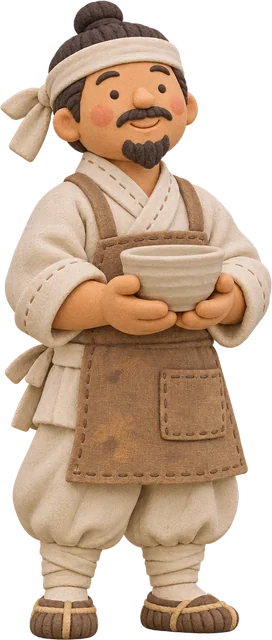
He is a Joseon potter said to have crossed to Japan with Shimazu Yoshihiro during the Jeongyu War (the second Japanese invasion), laid the foundation for Satsuma ware, and found white clay at Naeshirogawa to make White Satsuma.
What is the story of a potter who was brought away and made new pottery in a strange land? It is said that Park Pyeong-ui found white clay at Naeshirogawa in Satsuma and opened the way for White Satsuma. It is a story with both joy and pain.
More detail
Two sources checked
What kind of story is it when a potter who was taken away made new pottery in a strange land? Park Pyeong-ui is said to have been a potter born in Joseon in 1560.
Near the end of the Jeongyu War he crossed to Japan following Shimazu Yoshihiro and set up a kiln at Kushikino in Satsuma. A record says that more than 70 Koreans came over together. The people who crossed lived relying on one another amid unfamiliar language and customs.
Around 1603 he moved to Naeshirogawa (now Miyama, Hioki, Kagoshima Prefecture). It is said that there he found fine white clay and made white pottery. This is said to be the beginning of "white Satsuma" ware. Finding the new clay brought a big change, like accidentally discovering a tasty shop in the neighborhood in front of your school.
In 1624 he died at the age of sixty-five. The potters of Naeshirogawa kept Joseon customs and made pottery for generation after generation, and names such as the Shim Su-gwan family are known to this day. It is said that the potters kept Joseon speech and customs alive village by village, showing that technology and culture crossed over together.
The story of how the skills of people brought by force became a source of pride in Japan today holds both joy and pain. We should keep this in mind when remembering the pottery history of the two countries.
Life timeline
- 1560Said to have been born in Joseon
- 1598Crossed to Japan following Shimazu Yoshihiro
It is said to have been around 1598. - 1598Opened a kiln at Kushikino
The exact year differs by source. - 1603Moved to Naeshirogawa and opened a kiln
It is said to have been around 1603. - 1624Died