 BETA
Person
Saigyo
1118–1190 · Wandering poet-monk · Kamakura Shogunate
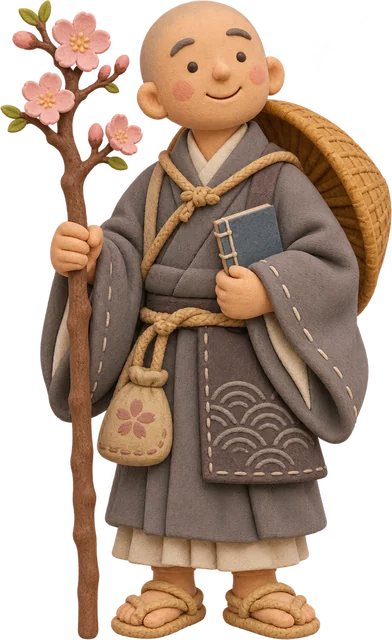
A warrior who became a monk at 23, he wandered the country composing poems. He left the Sankashu, had the largest number of poems in the Shin Kokin Wakashu, and met Yoritomo in Kamakura in 1186.
Why did a successful warrior become a monk? Saigyo became a monk at 23 and wandered the country writing poems. The story of his meeting with Yoritomo in Kamakura is also told. His poems are still read today.
More detail
Two sources checked
Why would a promising warrior suddenly give up everything? Saigyo was born into a warrior family and served as a Hokumen no Bushi (Northern Guard warrior) at the side of Retired Emperor Toba. But in 1140, at age twenty-three, he became a monk, surprising everyone. The reason is still not certain.
After becoming a monk he trained on the outskirts of Kyoto while composing poems, and traveled on foot through the Tohoku region, Mount Koya, and Shikoku. Unlike the showy poems of aristocratic society, many of his poems spoke honestly of nature and loneliness.
In the 1180s Japan was thrown into turmoil by the Genpei War. Saigyo kept composing poems even in this chaos, and it is told that while on his way to meet Fujiwara no Hidehira in the northeast for the fund to rebuild Todai-ji, he met Yoritomo in Kamakura in 1186. There is an anecdote that Yoritomo wanted to hear him talk about poetry and kept him all night.
Saigyo died in 1190 at Hirokawa-dera in Osaka. In life he had sung "I wish to die in spring beneath the cherry blossoms," and it is said that people were astonished that he breathed his last at around that time.
Saigyo is the poet with the most poems, 94, in the Shin Kokin Wakashu. It is also interesting that court poets such as Teika thought highly of his simple poems.
His poetry collection later had great influence on poets such as Matsuo Basho. The simple heart that makes you look up at the sky in the middle of a busy day is passed down unchanged even now.
Life timeline
- 1118Born in Kyoto
- 1140Became a monk at age 23
- 1144Traveled through the Tohoku region
- 1180Stayed on Mount Koya and watched the Genpei War
- 1186Met Yoritomo in Kamakura
- 1190Died at Hirokawa-dera