 BETA
Person
Saionji Kinmochi
1849–1940 · Last Genro (Elder Statesman) and Former Prime Minister · Empire of Japan
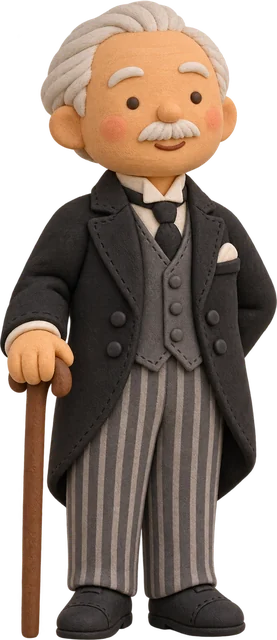
The last genro (elder statesman) who recommended prime minister candidates to the emperor from the Meiji era into the Showa era. Worried by the growing power of the military, he tried to protect parliamentary politics.
Who chose the prime minister? The last genro (elder statesman), Saionji Kinmochi, recommended candidates to the emperor. He tried hard to protect parliamentary politics to hold back the military, but as terrorism continued, he had no choice but to recommend prime ministers from the military instead of from the political parties. After he died in 1940, this brake was gone. His story shows how serious it is when no one is left to protect the system.
More detail
Two sources checked
At a time when there was no election to choose the prime minister directly, who decided who would be prime minister? Saionji Kinmochi was born into a noble family in Kyoto, took part in the Meiji Restoration, and was a free-thinking politician who had studied in France for a long time. He served twice as prime minister, and after 1912, as a genro (elder statesman), he took on the role of recommending prime minister candidates to the emperor.
After 1924 he was the last remaining genro. In the period when party cabinets continued, he worked to keep up the practice of recommending the leader of the party holding the majority in the Diet. To him this was a safeguard that kept the military and the bureaucracy from running politics as they pleased.
But in the 1930s, as terror and revolts by soldiers continued, the situation changed. After the May 15 Incident he recommended Saito Makoto, a naval man, instead of a party president, opening the era of "national unity cabinets." This was a choice made to avoid the worst, but it became the occasion for the break in party cabinets. In the February 26 Incident he was also an assassination target.
It was also he who recommended Konoe as prime minister in 1937. He died in 1940 at age 90, and afterward the genro system itself disappeared.
His life shows how quickly a country runs ahead once the "person who can apply the brakes" is gone. It also exposes the weakness of a politics that relied on people rather than institutions.
Life timeline
- 1849Born into a noble family in Kyoto
- 1871Went to study in France
He stayed for nearly ten years. - 1906Became prime minister for the first time
- 1924Became the last genro
- 1932Recommended Saito Makoto after the May 15 Incident
Party cabinets came to an end. - 1936Became a target in the February 26 Incident
- 1940Died
He died on November 24 at age 90.