 BETA
Person
Sen no Rikyu
1522–1591 · Master of the tea ceremony (wabi-cha) · Oda and Toyotomi Regime
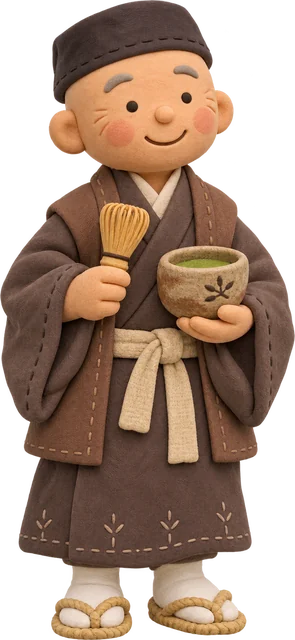
Born into a merchant family in Sakai, he perfected wabi-cha, a tea ceremony that finds beauty in simplicity, but in 1591 he was ordered by Hideyoshi to take his own life by seppuku.
Why did a single morning glory touch the heart of the ruler of all Japan? Rikyu perfected wabi-cha, a tea ceremony that finds beauty in simplicity, but in 1591 Hideyoshi ordered him to take his own life by seppuku. His story shows that the simplest things can have the deepest beauty.
More detail
Two sources checked
There was a time when "a single morning glory" moved the heart of the ruler of the realm. How did that happen? Sen no Rikyu was born in 1522 into a merchant family in the port city of Sakai. He was devoted to tea from childhood, and in 1544, at twenty-three, he held his first tea gathering that survives in the records.
Instead of showy Chinese porcelain he used simple, rough vessels, and he developed wabi-cha, in which host and guest sit face to face in a small tearoom. Nobunaga and Hideyoshi also used the tea ceremony in politics. At a tea gathering held in the palace in 1585 he received the name "Rikyu" from Emperor Ogimachi.
At the Grand Kitano Tea Gathering in 1587 he helped Hideyoshi and set up more than 800 seats. A story is told that when Hideyoshi came to see the morning glories in full bloom in Rikyu's garden, they had all been cut, and only a single flower was set in the alcove (tokonoma) in the room. The story is that by leaving only one, he made the beauty felt even more greatly. It is similar to hanging a single small picture alone while the whole class hangs showy pictures.
It is also said that after he completed the main gate of Daitokuji Temple in 1589, placing a wooden statue of himself on the upper floor became a problem. Even now the reason is not known exactly. In 1591 Hideyoshi ordered Rikyu to commit seppuku, and he died at the age of seventy.
The spirit of "one time, one meeting" and the beauty of simplicity that Rikyu left remain throughout Japanese tea ceremony, architecture, and design to this day. His stubbornness in keeping his own taste even before power created a new beauty.
Life timeline
- 1544A record of his first tea gathering survives
- 1585Received the name "Rikyu" at the palace tea gathering
- 1587Helped with the Grand Kitano Tea Gathering
- 1589Completed the main gate of Daitokuji
- 1591Committed seppuku on Hideyoshi's order