 BETA
Person
Shiga Kiyoshi
1871–1957 · Bacteriologist · Empire of Japan
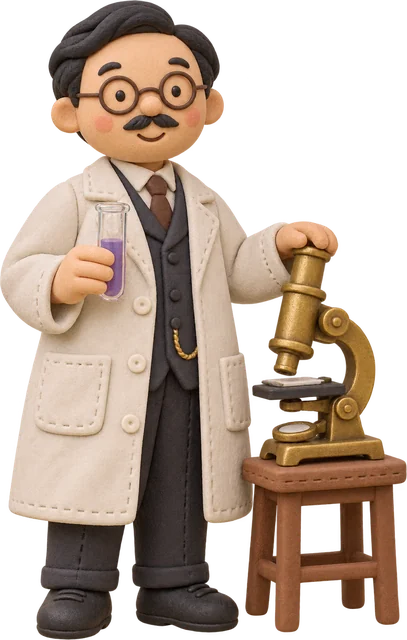
Shiga Kiyoshi, from Sendai, was a student of Kitasato Shibasaburo. In 1897-98 he found the germ that causes bacillary dysentery (the Shiga bacillus), discovered a chemotherapy drug under Paul Ehrlich in Germany, and also served as president of Keijo Imperial University.
How did he find the culprit of a disease that swept through villages? Shiga Kiyoshi found the dysentery germ under his teacher Kitasato, and in Germany he also discovered a chemotherapy drug. With patience he uncovered the true nature of the disease and saved many people.
More detail
Two sources checked
How did the search for the culprit behind a disease sweeping through villages begin? Shiga Kiyoshi was born in 1871 in Sendai. In 1896 he graduated from the medical school of the University of Tokyo and joined the Institute for Infectious Diseases led by Kitasato Shibasaburo.
In 1896 in Japan, many people fell ill and died of dysentery. Dysentery is a disease that causes severe diarrhea in the stomach, and once it spread it was hard to handle. Shiga repeatedly examined patients' stools and grew bacteria to check them. In 1897-98 he found the bacterium that causes dysentery, which was called the 'Shiga dysentery bacillus.' This bacterium led to a genus (Shigella) that today takes its scientific name from his name.
In 1901 he studied in Germany under Paul Ehrlich, researching chemotherapy, curing disease with chemical substances. There he discovered a drug called 'trypan red,' which was used in sleeping sickness research and is regarded as the first chemotherapy agent.
After returning he continued research on dysentery vaccine, tuberculosis, and leprosy, and served as a professor at Keio University. In the 1920s he served as a professor and also as president at Keijo Imperial University, which was set up in Korea. Because this university was a school Japan built in colonial Korea, opinions about it are divided. He died in 1957 at the age of eighty-six.
One person's persistence uncovered the identity of a disease and saved many people. That hygiene education and vaccines are with us today is also thanks to him.
Life timeline
- 1896Graduates from the University of Tokyo medical school and joins the Institute for Infectious Diseases
- 1898Discovers the dysentery bacillus
Some sources present it as a discovery of 1897. - 1901Studies in Germany
- 1944Receives the Order of Culture
- 1957Dies