 BETA
Person
Shigemitsu Mamoru
1887–1957 · Diplomat and Foreign Minister · State of Japan
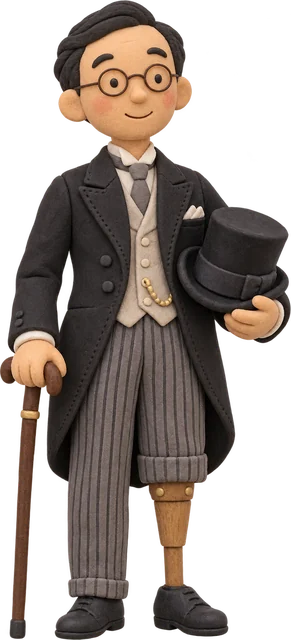
Shigemitsu Mamoru was the foreign minister who signed the surrender document on behalf of the Japanese government aboard the USS Missouri on September 2, 1945. At the Tokyo Trial he received seven years in prison, but he returned to public life and led Japan's entry into the United Nations in 1956.
Who stepped forward to sign the surrender document? As foreign minister, Shigemitsu Mamoru signed for the Japanese government on September 2, 1945, aboard the American battleship Missouri. He later received seven years in prison at the Tokyo Trial, but after his release he worked for Japan's entry into the United Nations in 1956. He lived through both responsibility for the war and the restoration of peace, so opinions of him are complicated.
More detail
Two sources checked
What was in the heart of the man who stepped forward to sign the surrender document? Shigemitsu Mamoru was born on July 29, 1887, in Oita Prefecture. In 1911 he graduated from the Faculty of Law at Tokyo Imperial University and entered the Foreign Ministry. As a diplomat he served as minister to China and ambassador to the Soviet Union, among other posts.
In 1932, while he was minister to China, he was attacked with a bomb at a ceremony in Shanghai and lost his right leg. He nevertheless continued as a diplomat, became ambassador to the Soviet Union in 1936, and served as foreign minister in the Tojo cabinet in 1943 and the Koiso cabinet in 1944.
After the defeat in 1945 he became foreign minister in the Higashikuni cabinet, and on September 2, aboard the American battleship Missouri in Tokyo Bay, he signed the surrender document first on behalf of the Japanese government. There were two Japanese representatives, Shigemitsu and the military representative Umezu Yoshijiro. What he felt standing there is hard to know from the records.
In 1948 the Tokyo Trial sentenced him as a Class A war criminal to seven years' imprisonment, but he was released around 1952 and returned to politics. In 1954 he became vice president of the Japan Democratic Party, and in 1956, as foreign minister in the Hatoyama Ichiro cabinet, he worked for the restoration of Japan-Soviet relations and Japan's entry into the United Nations. He died in January 1957 at the age of 69.
His life receives mixed assessments because the same man experienced both responsibility for the war and the work of restoring peace. It shows that what a person does after defeat can rebuild a nation's trust.
Life timeline
- 1887Born in Oita Prefecture
July 29. - 1911Graduated from Tokyo Imperial University and entered the Foreign Ministry
He took the path of a diplomat. - 1932Attacked with a bomb in Shanghai and lost a leg
It happened while he was minister to China. - 1943Foreign minister in the Tojo cabinet
He also served as foreign minister in the Koiso cabinet in 1944. - 1945Signed the surrender document on the Missouri
He was foreign minister in the Higashikuni cabinet. - 1948Seven years' imprisonment at the Tokyo Trial
He was sentenced as a Class A war criminal. - 1956Japan-Soviet relations restored and Japan joined the UN
He was foreign minister in the Hatoyama Ichiro cabinet. - 1957Died
January 26, at the age of 69.