 BETA
Person
Shimomura Osamu
1928–2018 · Marine biologist and chemist, Nobel Prize in Chemistry winner · State of Japan
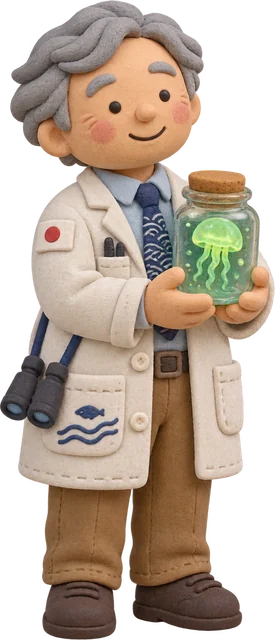
Shimomura Osamu studied the light-producing substances of firefly squid and jellyfish, and in 1962 discovered green fluorescent protein (GFP) in jellyfish. This discovery became a tool for medical and biological research, and he received the Nobel Prize in Chemistry in 2008.
How did the green glow of a jellyfish help medical research? While studying the light substances of firefly squid, Shimomura Osamu discovered green fluorescent protein in a jellyfish in 1962. This protein lets us see inside cells, and he received the Nobel Prize in Chemistry in 2008. The curiosity that gathered small sea creatures lit up human research.
More detail
Two sources checked
How did the green light of a jellyfish in the sea help cancer and brain research? Shimomura Osamu was born in Fukuchiyama, Kyoto Prefecture, in 1928. He graduated from the Pharmacy Special Course attached to Nagasaki Medical College in 1951 and worked as an assistant at the same university. It is said that in his boyhood he experienced from afar the atomic bomb that fell on Nagasaki.
In 1955, researching at Nagoya University, he succeeded in crystallizing luciferin, the light-producing substance of the sea firefly (umihotaru) (some sources say 1957). In 1960 he became a Doctor of Science and went to Princeton University in the United States as a Fulbright scholar.
In 1962 he discovered green fluorescent protein (GFP) together with aequorin, a light-producing protein, from the jellyfish Aequorea. It was achieved by collecting huge numbers of jellyfish from the sea himself. He then continued research at Princeton and, from 1982, at the Marine Biological Laboratory at Woods Hole until 2001.
GFP was later used by other researchers as a marker that lets people see with their eyes where genes and proteins move inside cells, and in 2008 he shared the Nobel Prize in Chemistry with Martin Chalfie and Roger Tsien. He died in Nagasaki in October 2018.
In today's terms, just as a single flashlight lights the way in a dark room, a small sea creature became a guide in the laboratory. One curious person's collecting lit up humanity's research.
Life timeline
- 1928Born in Fukuchiyama, Kyoto Prefecture
August 27. - 1951Graduated from the Pharmacy Special Course attached to Nagasaki Medical College
Became an assistant at the same university. - 1955Crystallized the luciferin of the sea firefly
Researched at Nagoya University (some say 1957). - 1960Doctor of Science; study in the United States
A Fulbright scholar. - 1962Discovered the jellyfish's aequorin and GFP
An achievement made at Princeton University. - 1982Marine Biological Laboratory at Woods Hole
Worked there until 2001 as a senior researcher. - 2008Nobel Prize in Chemistry, Order of Culture
Shared with Chalfie and Tsien. - 2018Died
October 19, in Nagasaki.