 BETA
Person
Takamine Jokichi
1854–1922 · Applied Chemist and Businessman · Empire of Japan
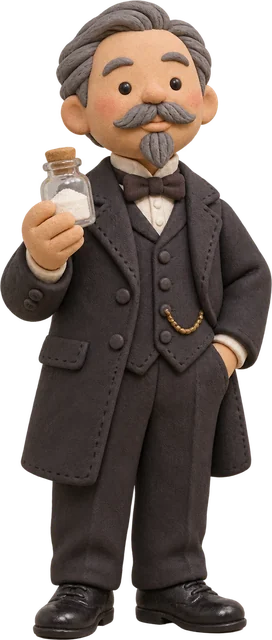
Takamine Jokichi, son of a doctor of the Kaga domain, studied in Britain and then went to the United States. In 1894 he made the digestive medicine Takadiastase from koji mold, and in 1900 he extracted the hormone adrenaline in crystal form, opening the way for medicines and hormone research around the world.
What if the koji used to brew liquor could become medicine? In the United States, Takamine Jokichi made the digestive medicine Takadiastase from koji mold and extracted the hormone adrenaline as crystals. Japan's traditional skill became science for the whole world.
More detail
Two sources checked
What happens if the koji mold used to brew sake becomes medicine? Takamine Jokichi was born in 1854 in a family of physicians in the Kaga domain. After studying in Nagasaki and at the Tekijuku school in Osaka, he graduated from the chemistry department of the Imperial College of Engineering (Kobu Daigakko) in 1879.
He studied in Britain from 1880, and after returning worked as an engineer at the Ministry of Agriculture and Commerce. In 1884 he took part as Japan's representative at the New Orleans Exposition in the United States, where he met an American woman whom he later married. He then crossed to the United States and devoted himself to research.
In 1894 he extracted a powerful digestive enzyme from Japanese koji mold and named it 'Takadiastase.' The American drug company Parke-Davis began selling it, and it spread around the world. In 1900 he succeeded in extracting adrenaline in crystal form from the adrenal glands of animals, which is regarded as the first case of obtaining a hormone in pure form. At the same time, there was also a dispute among researchers over priority.
In Japan he served as the first president of Sankyo Shoten (later Daiichi Sankyo) and helped found the Kokumin Kagaku Kenkyusho (National Science Institute, later RIKEN). It is said he also helped with the gift of cherry trees along the Potomac River in Washington in 1912. He died in New York in 1922.
His life, which linked the knowledge of East and West, shows that Japan's traditional fermentation technology can also become part of world science.
Life timeline
- 1879Graduates from the chemistry department of the Imperial College of Engineering
- 1880Studies in Britain
- 1884Sent to the New Orleans Exposition
- 1894Develops Takadiastase
- 1900Succeeds in crystallizing adrenaline
- 1912Receives the Imperial Academy Prize
- 1922Dies in New York