 BETA
Person
Tange Kenzo
1913–2005 · Architect · State of Japan
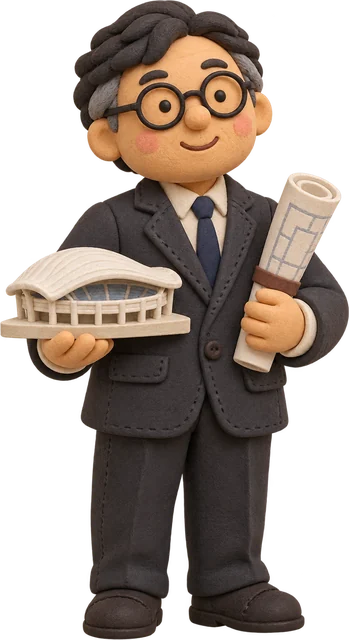
Tange Kenzo was an architect who won first place in the 1949 design competition for the Hiroshima Peace Memorial Park, designed the 1964 Tokyo Olympic arena (Yoyogi National Gymnasium), and showed modern Japanese architecture to the world through his plan for the 1970 Osaka Expo and the 1987 Pritzker Prize.
How do you build a symbol of peace in a ruined city? The architect Tange Kenzo won first place in the 1949 design competition for the Hiroshima Peace Memorial Park, built the Yoyogi Gymnasium for the 1964 Tokyo Olympics, and received the Pritzker Prize in 1987. His buildings, which seem to soar into the sky, gave people the heart to start again.
More detail
Two sources checked
How can a symbol of peace be built in a city lying in ruins? Tange Kenzo was born on September 4, 1913. There is a theory that he was born in Osaka and another that he came from Imabari in Ehime Prefecture, and he spent his childhood in the Shanghai international settlement. In 1938 he graduated from the architecture department of Tokyo Imperial University and worked until 1941 in the office of Maekawa Kunio, a student of Le Corbusier.
In 1942 he won first prize in the design competition for the Greater East Asia Co-Prosperity Sphere Construction Memorial Building Project, which made his name known. After the war, in 1946, he became an associate professor at the University of Tokyo, and in 1949 he was chosen first in the design competition for the Hiroshima Peace Memorial Park and museum. The task was to build the center of a new city on the ruins.
In 1961 he opened the Urban and Architectural Design Institute and published "Tokyo Plan 1960." In 1964 he completed the National Gymnasium (Yoyogi Gymnasium) for the Tokyo Olympics and St. Mary's Cathedral in Tokyo, and in 1970 he took charge of the master plan for the Osaka World Exposition.
He retired from the University of Tokyo in 1974, and received the Order of Culture in 1980 and, in 1987, the Pritzker Prize, called the Nobel Prize of architecture. He died in Tokyo in March 2005.
His buildings are striking for roofs whose curves seem to soar into the sky. In today's terms, like the moment a new gym rises on a ruined schoolyard, they gave people the feeling that they could start again.
Life timeline
- 1913Born
September 4. There are theories that his birthplace was Osaka or Ehime Prefecture. - 1938Graduated from the architecture department of Tokyo Imperial University
He worked in the office of Maekawa Kunio. - 1942First prize in the design competition for the Greater East Asia Co-Prosperity Sphere Construction Memorial Building Project
He became known as an architect. - 1949First prize in the Hiroshima Peace Memorial Park design competition
He designed a symbol of peace. - 1961Opened the Urban and Architectural Design Institute
He published "Tokyo Plan 1960." - 1964Completed Yoyogi Gymnasium and St. Mary's Cathedral
They became symbols of the Tokyo Olympics. - 1970Master plan for the Osaka World Exposition
His influence widened through urban planning. - 1987Pritzker Prize
He was recognized as an architect of world standing.
Related events
- 1945Atomic Bombings of Hiroshima and Nagasaki
- 1955High Economic Growth, the Shinkansen, and the Tokyo Olympics
- 1970Osaka World Expo